






Christina Rossetti, the finest poetess of the Victorian era, was born into a remarkably gifted family in London, on December 5, 1830. Her parents, Gabriele and Frances Rossetti, were emigrés from Italy. When they came to England, they began attending All Souls, Langham Place, where Christina was baptized shortly after her birth. Though the family was gifted artistically, they had little money and seem to have struggled financially, despite the fact that her father was a Professor of Italian at King’s College, London. It was from her mother that she imbibed her evangelical faith.
In 1848 Christina became engaged to James Collinson, a Pre-Raphaelite artist like her brother Dante Gabriel Rossetti (1828‒1882), but the engagement ended in 1850 after he joined the Roman Catholic Church. Collinson went on to enter a Jesuit college, though he would leave without being ordained. When her father’s failing health and eyesight forced him to retire from teaching in 1853, Christina and her mother attempted to support the family by starting a day school but had to give it up after a year or so.
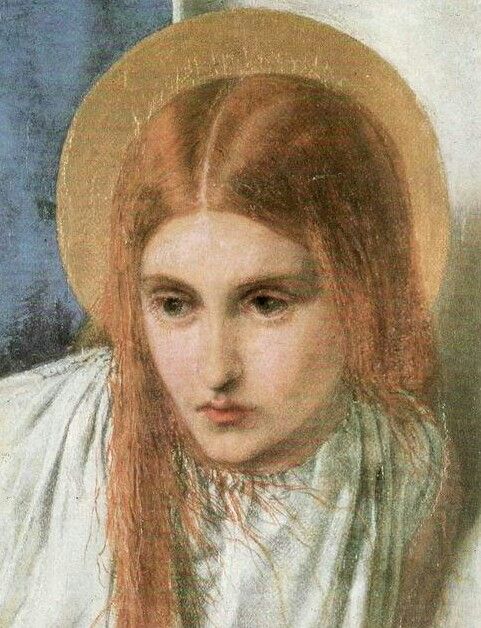
From the early 1860s on she was passionately in love with a man by the name of Charles Cayley. Cayley had a remarkable facility for languages, being a master of Hebrew, Homeric and classical Greek, and Italian. He even oversaw a translation of the New Testament into Iroquois.[1] In 1864 he proposed to Christina, but she refused to marry him because “she enquired as to his creed, and she found that he was not a Christian; either absolutely not a Christian, or else so far removed from fully defined religious orthodoxy that she could not regard him as sharing the essence of her own beliefs.”[2]
Thereafter she led a very life of seclusion, interrupted by a recurring illness that was sometimes diagnosed as angina and sometimes tuberculosis. In midlife she did suffer from a condition known as Graves’ disease that led to her becoming quote overweight and developing discoloured skin. Her brother William Michael describes her during this period as “a melancholy wreck.”[3] But she recovered a large portion of her health after a number of years.
Her final three years—she died on December 29, 1894—were spent suffering from breast cancer, which involved surgery at home in 1892 and much pain and suffering. Her faith was deeply tested, and not surprisingly there is sometimes a morbid, introspective streak in statements she made at this time and in her poetry. One day she said to her brother William Michael (1829‒1919), for example, “How dreadful to be eternally wicked! for in hell you must be so eternally—not to speak of any question of torments.”[4] And in the last poem she penned before her death in 1894 at the age of sixty-four, she wrote this clear response to the trying circumstances of her life:
Sleeping at last, the trouble & tumult over,
Sleeping at last, the struggle and horror past,
Cold and white, out of sight of friend and lover,
Sleeping at last.[5]
Solus Christus
But there is another, and one might say a deeper, side to Christina.[6] She was a Christian, to some degree influenced by Anglo-Catholicism, but having a decidedly evangelical cast to her mind.[7] Listen, for instance, to this poem, written in 1893 near the end of her life. It is a poem that echoes the watch-cry of the Reformation—Christ alone.
None other Lamb, none other Name,
None other Hope in heaven or earth or sea,
None other Hiding-place from guilt and shame,
None beside Thee.
My faith burns low, my hope burns low,
Only my heart’s desire cries out in me
By the deep thunder of its want and woe,
Cries out to Thee.
Lord, Thou art Life tho I be dead,
Love’s Fire Thou art however cold I be:
Nor heaven have I, nor place to lay my head,
Nor home, but Thee.[8]
In the bleak mid-winter
Evangelicals are probably most acquainted with Rossetti through her Christmas carol, In the bleak mid-winter.[9] It first appeared in Scribner’s Monthly, a New York magazine, in January 1872. It was written in the midst of Christina’s suffering from Graves’ disease.
Christina sets the birth of Christ against the backdrop of the bleakness of a chilly English winter and gives a series of vivid contrasts between his heavenly state and that to which he stooped when he became a human being. The first stanza sets the scene:
In the bleak mid-winter
Frosty wind made moan,
Earth stood hard as iron,
Water like a stone;
Snow had fallen, snow on snow,
Snow on snow,
In the bleak mid-winter
Long ago.
What is the key-word here? “Bleak.” Christina is not merely describing the weather but speaking of an inner winter. And the word “bleak” prepares the reader for the intense images that follow: the wind that “made moan,” the earth as stiff and solid as iron, and the water so frozen it was like a stone. And the way she drops these intense images one on top of another is like what is described in the second half of this verse: layer upon layer of snow. The repetition of the first line reinforces the picture that Christina wishes to depict: the utter bleakness of the winter.[10]
Our God, Heaven cannot hold Him
Nor earth sustain;
Heaven and earth shall flee away
When He comes to reign:
In the bleak mid-winter
A stable-place sufficed
The Lord God Almighty
Jesus Christ.
From a picture of bleak winter we are taken to the theme of the governance and upheaval of the universe. The first two lines come from 1 Kings 8:27. They remind us of the greatness of God—the awesomeness of his person. Lines 3 and 4 are from Revelation 20:11: “Then I saw a great white throne and Him who sat on it, from whose face the earth and the heaven fled away.” Here, from another angle, the awesomeness of our God is being stressed. Before him the universe will melt.
Commonly linked to Christmas in the Christmas tradition is the Second Coming. The link obviously is the fact that both involve the coming of Christ to this world. But how different they are: at his Second Advent, Christ will come as an awesome warrior-king who will re-create the entire universe. But at his first coming: a stable was sufficient to house him—this One whom the universe cannot contain (note: the reference to Jesus as “Lord God Almighty,” drawn from texts like Revelation 1:8, 11, 17; 21:22). Finite earth and heaven are far too small a container for the Infinite God. Yet, when he comes as the Incarnate One, he enters this world in the cramped quarters of a stable.
Enough for Him whom cherubim
Worship night and day,
A breastful of milk
And a mangerful of hay;
Enough for Him whom angels
Fall down before,
The ox and ass and camel
Which adore.
Angels and archangels
May have gathered there,
Cherubim and seraphim
Throng’d the air,
But only His mother
In her maiden bliss
Worshipped the Beloved
With a kiss.
Again, there is a vivid contrast. In heaven angelic worship of his glorious being is never-ending and unceasing. But when he comes to dwell on this earth, he is content with the worship of animals and of his Virgin mother. Were there angels to worship at the birthplace of Christ? We are not told so in the nativity stories in Matthew and Luke. Also observe the Protestant tone expressed in the fact that his mother worshipped him. But still the key emphasis is the contrast. As Christina wrote in another Christmas poem: “Christmas bringeth Jesus,/Brought for us so low.[11]
What can I give Him,
Poor as I am?
If I were a shepherd
I would bring a lamb,
If I were a wise man
I would do my part,
Yet what I can I give Him,
Give my heart.
Central to Christina’s meditation on the meaning of Christmas, though, is not simply its mysterious paradoxes, but this question: how should we properly respond to the coming of Jesus Christ, the Lord God Almighty, into our world? The shepherds and the Magi have gifts that match the parts they play in the Christmas story—but what of us, who are also called to participate in this drama, what can we give? Christina sees herself as having nothing to give, for she is “poor.” Her poverty is her whole self.[12]
But she—and we—can give to him something unique and therefore doubly precious: our hearts, the centre and core of our beings. She made a similar appeal in A Carol for Children:
I must be like those good Wise Men
With heavenward heart and look:
But shall I give no gifts to God?
What precious gifts they took!
Lord, I will give my love to Thee,
Than gold much costlier,
Sweeter to Thee than frankincense,
More prized than choicest myrrh…[13]
So, what of you, dear reader? Will you give him your heart afresh this Christmastide?
[1] William Michael Rossetti, The Pre-Raphaelites & their World: A Personal View (London: The Folio Society, 1995), 105.
[2] Rossetti, The Pre-Raphaelites & their World, 106.
[3] Rossetti, The Pre-Raphaelites & their World, 213.
[4] Rossetti, The Pre-Raphaelites & their World, 216.
[5] Christina Rossetti, “Sleeping at last, the trouble & tumult over” in her The Complete Poems, ed. R. W. Crump (London: Penguin Books. 2001), 871.
[6] See Georgina Battiscombe, Christina Rossetti: A Divided Life (London: Constable, 1981), 13‒14.
[7] Erik Routley, Hymns and Human Life, 2nd ed. (Grand Rapids, MI: Wm. B. Eerdmans Publishing Co., 1959), 218; idem, A Panorama of Christian Hymnody (Collegeville, MN: Liturgical Press, 1979), 116.
[8] Christina Rossetti, “None other Lamb, none other Name” in her Complete Poems, 410.
[9] For this poem, see her Complete Poems, 210‒211.
[10] J. R. Watson, The English Hymn. A Critical and Historical Study (Oxford: Clarendon Press, 1997), 457‒458.
[11] Christina Rossetti, “Christmas Eve” in her Complete Poems, 421.
[12] Watson, English Hymn, 459.
[13] Christina Rossetti, Poems: Feasts and Fasts (London: Fount, 1996), 11.