






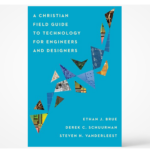
A Christian Field Guide to Technology for Engineers and Designers by Ethan J. Brue, Derek C. Schuurman, and Steven H. VanderLeest. 2022. 240 pages
I recently learned of a software developer who built a Christian AI app because, in his own words, he had an “existential crisis.”
His story is no different from one I’ve heard many times before, whether at FaithTech events, the broader “faith and work” community, or in my good friend, Joel Jacob.
Joel has worked at Toyota, Ecobee, and Splunk (Cisco). He loves building things. Like a kid with a new bag of Lego bricks, Joel finds joy in tinkering through design iterations, pressing through each bug and failure, and getting to the point of seeing the work of his hands succeed.
But a few years ago, he had an existential crisis. What’s the point of all his productivity? Building alone couldn’t be it. Was he working for the world or for God’s Kingdom? Was he designing fishing boats instead of fishing for men? What was God calling him to?
Many Christian engineers face this challenge. They need more than advice, they need existential grounding, they need an ethical framework and an ultimate telos to guide their technological pursuits.
To help people like Joel, I always recommend the book ‘A Christian Field Guide for Engineers and Designers’, which answers these questions. Most Christian books on technology these days highlight flaws and destructive impacts—and we need those warnings—but we also need to inspire engineers and designers to love their neighbour by building great tech.
A core theme throughout the book is the holistic way Christian engineers and designers ought to approach work. The three authors, all experienced in industry, make note of design norms that have been developed within the reformed Christian tradition and can be applied to the tech of today. These are built on the ‘modal aspects of reality,’ coined by the Dutch philosopher Herman Dooyeweerd, who considered “in what distinct ways is it possible to see things, understand and interact with things.”
The building of great products begins in great dreams, from man’s first steps on the moon to the voyage of a ship in a 150-day flood. Chapter one encourages builders to imagine their work in light of God’s cultural mandate to fill the earth. Chapter two walks through a biblical theology of technology. God placed latent potentiality for innovation in creation, but it was distorted in the Fall, which is why we need Jesus Christ to redeem all technology himself (Col. 1:20).
Christian technologists bear a responsibility for both how they build and how their product behaves. Chapter three unpacks a biblical framework for responsibility, such as the law to build a parapet on the roof of one’s own house for other people who might walk on it (Deut. 22:8). This means builders ought to design for the safety of others but the users themselves bear responsibility for how they use technology (a parapet was only a short railing, not a cage).
Chapter four gets technical, breaking down the modal aspects of reality and how they impact design norms, but it alone is worth the price of the book. By categorizing every aspect of reality, the associated design norms allow engineers and designers to consider the aspects of culture, justice, aesthetics, stewardship, harmony, and more. God wants us to design products that are beneficial and beautiful, enhancing cohesive communities of shalom rather than self-centered devices of despair.
Some design norms are obvious, are shared with almost every culture, and are often normed in ethical standards. Hence, this Christian Field Guide makes repeated references to industry standards and non-Christian institutions—they provide great value! But Christian design norms go beyond the cultural minimum, as we believe that each bolt is tightened and every piece of code is written before the face of God.
Builders must take a step out of their work and examine it using deontological ethics, consequentialism, and virtue ethics, while noting the limitations of each of these approaches when used without the others. Christians must think and build holistically, taking into consideration how technology amplifies both benefits and drawbacks.
The remaining chapters continue to apply the design norms across examples in the past (like the electric bicycle) to possibilities of the future, including the flaws of transhumanism and the features of a hopeful realism. The authors take the effects of sin seriously without losing hope in God’s plan to bring about a new creation.
Engineers and designers who are Christians do not need to leave their jobs but can glorify God in doing them well. Don’t quit! You have a calling. The charge placed on me, on Joel, and everyone working in technology, is to love our maker and our neighbour in what we make.
As a Canadian, the book represents something of a reminder to me of the need for Canadian institutions. One of the authors, Dr. Derek Schuurman, was born and raised in Canada and taught for many years at Redeemer University (just north of Hamilton). In 2016, Redeemer felt they no longer had the resources for a Computer Science program and let Derek go (a decision they have since apologized for). Like many Canadian theologians, he now works in the United States, where there’s an income to support his family.
Right now, you and I may not be able to launch new Christian centers of learning, but we can read great books. And we can give books like this one to students who are studying engineering or design, or to those already working in the workforce. In doing so, we lay the groundwork for future engineers and designers to stand on.