


Understanding history is essential, and this book, A “phoenix of women:” Puritan spirituality in the letters of Brilliana Harley, introduced and edited by Michael A.G. Azad Haykin, helps us to do just that. By carefully examining the lessons, experiences, and wisdom in the writings of Lady Brilliana Harley, we are better equipped to thoughtfully shape a more meaningful and purposeful future for our own children.
We are living in a day where knowledge of our past is limited. As a society in general, we do not know what our ancestors believed, and as Christians, we do not know how they experienced God or how our churches were shaped by their beliefs. We need to challenge ourselves with the past to gain wisdom for the present and future.[1] These writings from the seventeenth century should not be left there for the original readers alone; God allowed them to be preserved for us to read. God kept Brilliana firm in her faith and allowed her to use her experiences to encourage us today.
The roles and perspectives of women and mothers have changed drastically since the seventeenth century. The contemporary post-feminist worldview stands in stark contrast to the puritan way of life, representing a fundamental shift in values and social expectations. For the Puritans, the family unit was considered the cornerstone of society, serving both spiritual and social purposes. While both husband and wife shared responsibility for the nurturing and guidance of the household, the Puritan model operated within a structured order, with the husband serving as the head of the home and the wife fulfilling her role in faithful submission to his leadership. Christian parenting is being challenged by deconstructive postmodern thought, which sees the nuclear family as something to be dismantled, upending the notion of family that we have inherited from the Judeo-Christian worldview. Rather than rely upon an assumed understanding of the lack of importance of the family for society, Christian parents today must show society the importance of the family by living out a Christian vision of what family looks like. We must reform our own families first.
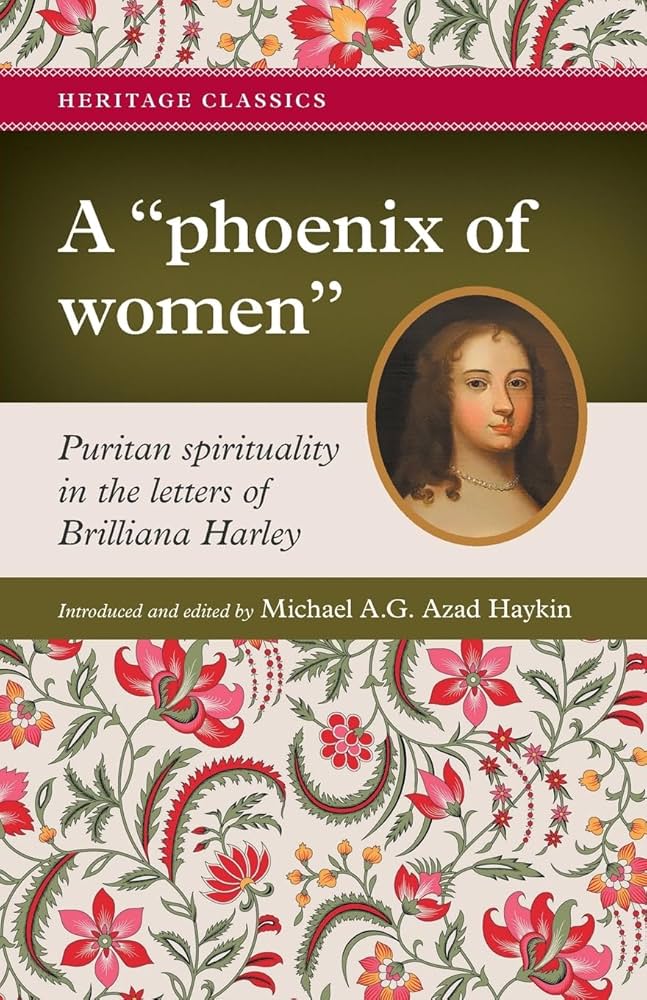
A "phoenix of women": Puritan spirituality in the letters of Brilliana Harley
Michael A G Haykin, Brilliana Harley
Purchase on AmazonA "phoenix of women": Puritan spirituality in the letters of Brilliana Harley
Michael A G Haykin, Brilliana Harley
What an immeasurable blessing it is to have the inspiring legacy of Brilliana, a faithful Puritan woman, alongside many other great women of the faith who have walked before us. These women throughout the centuries give us examples to draw on for wisdom, encouragement, and strength as we navigate parenthood today. We need not feel alone or pressured to conform to the ever-shifting secular standards of our modern age, where faith is increasingly private, and the family no longer holds the rightful place as the seminary of society. In looking back, we are reminded that we are part of a long line of Christian parents who have been called and equipped by God to faithfully pass on our faith to our sons and daughters.
A “Phoenix of Women”
The title of the book is drawn from Robert Harley’s (1579–1656) funeral, where his wife, Brilliana (1599–1643), who died thirteen years earlier, was referred to as “that noble lady and phoenix of women” by Thomas Froysell. Haykin, along with other historical writers, identified and pulled this phrase from the funeral sermon because a phoenix was representative of the resurrection in Christian tradition and sixteenth- and seventeenth-century literature and theology used the phoenix as a symbol of both literal and figurative resurrection. In the case of Brilliana, “phoenix” was used as a poetic metaphor for an exemplary individual. Lady Brillian Harley was an exemplary woman who defended her principles and castle from 1639 until her death in 1643.
The book opens with a foreword written by Jenny-Lyn de Klerk, who wrote 5 Puritan Women: Portraits of Faith and Love. (It was after reading de Klerk’s book, which includes a chapter on Brilliana Harley, that I first picked up Haykin’s book.) Next is an essay by Haykin, which introduces readers to the life and spirituality of Brilliana. Following this is a collection of letters by Brilliana. Haykin includes thirty-eight of the “best” letters Brilliana wrote to her husband, their son Ned, while he was away at school, prominent politicians, and King Charles I. The four Appendices include letters to Lady Brilliana, such as one from Charles I himself.
The letters Haykin includes in the book bolster his essay about her spirituality. In his essay, Haykin provides historical context for the letters. He gives a brief biography of Harley’s early years and her early marriage, and then gives us a glimpse of the war she found herself living in and the subsequent siege of her castle. Haykin also introduces the reader to Edward—Brilliana’s son—who was the recipient of many of her letters. Haykin concludes his essay with a glimpse into Brilliana’s spirituality. This essay provides context for the letters that make up the core of the book.
The letters themselves show us that Puritan women such as Brilliana are worthy of our interest, as they had great insight into the Christian life and were very skilled at applying Biblical principles to their day-to-day lives. They are wonderful examples of Christian living as they devoted themselves to God by using spiritual disciplines and by passing on their faith to their children and neighbours. Brilliana’s letters compiled here by Haykin reflect her strong religious commitment and the changing political climate, and, at the same time, we see her concern for her husband and son as they lived in London, away from her and the castle.
Brilliana as a Christian Mother
While there are many themes that could be highlighted from Brillianna’s letters, the one that stood out to me concerned her role as a mother. Reading through the compilation of Brilliana’s letters reveals her heart for her family. Written out of concern for Ned’s physical and spiritual well-being, these letters offer us a detailed picture of Puritan motherhood in action. Through their correspondence, Brilliana’s love and care are apparent—and there is much we can learn from her example. She used her letters to consistently encourage Ned in how to live the Christian life in regular prayer, reading of scripture, and observing the Sabbath. From this, we learn that a mother is to care for the whole person, body and soul. Encouraging Ned to examine his own heart was important to Brilliana as a Puritan mother—she understood that guiding Ned’s spiritual formation was her responsibility. From this, we learn that mothers have a responsibility for their children’s spiritual lives, and we must steward our children well.
Brilliana knew that faith was not meant to be lived in isolation, and so she actively encouraged Ned to find a community of believers to help him grow, keep him accountable, and walk alongside him in faith. She pointed him toward the broader body of Christ rather than trying to be everything to her son. We learn from her that good mothering releases children to live their lives alongside their brothers and sisters in Christ. Brilliana lived a life of service and encouraged Ned to serve others in his life. Brilliana was inviting Ned to live as she did, and thereby she teaches us that sometimes the most powerful lessons we can teach our children are by means of the life we live.
Conclusion
It is important to understand history. We learn from the past to shape our future. It is when we listen to women like Brilliana that we understand what the Puritans believed about family discipleship and worship. A “phoenix of women” helps us tremendously in this way and is to be recommended for a wide range of readers. This book challenges us, among other things, to think about the role of the mother in the discipleship of her children. And in spite of the changes that take place so rapidly in the culture around us, Brilliana’s voice offers us edification and instruction and challenges us to stand on God’s unchanging truth and faithfulness.
[1] While reading this book and thinking through this topic, I am indebted to these books and articles that helped me formulate my thoughts. Raymond A. Anselment, “Katherine Paston and Brilliana Harley: Maternal Letters and the Genre of Mother’s Advice,” Studies in Philology 101, no. 4 (September 2004): 431–453; Jenny-Lyn de Klerk, 5 Puritan Women: Portraits of Faith and Love (Wheaton, IL: Crossway, 2023); Antonia Fraser, The Weaker Vessel: Woman’s Lot in Seventeenth-Century England (London, UK: Weidenfeld and Nicolson, 1984); Johanna Harris and Elizabeth Scott-Baumann, eds., The Intellectual Culture of Puritan Women, 1558–1680 (London, UK: Palgrave Macmillan, 2011).