








I thought Christian testimonies would affect me less as the years went on, but I was wrong. I assumed that as I got further away from my own moment of new birth, those stories would steadily lose their particular power. Although I loved a good testimony when I was a young zealous convert, I also had a lot of naive optimism about life, about how easily and how often people’s lives and hearts would change in an instant of divine grace. Of course God changed your life! He changed mine. I now realize that, in a way, I took those testimonies for granted.
Life, with its inevitable heartbreaks, losses, and frustrations, has tempered my expectations. I still pray for such transformations and know God can do them, but I also know that there are many faithful prayer warriors who have yet to see their prayers answered. Sin, hardness of heart, and spiritual darkness are pervasive and tenacious. And so, even more than when I was that young convert, stories of God’s transforming grace have the power to move me deeply.
Seeking Transformation
I realized this as I read a remarkable new memoir, TransFormed, by Kyla Gillespie (B&H, 2026). Kyla, a former professional women’s hockey player from British Columbia, has had quite the journey. Born into a nominally Christian home, her idyllic childhood was shattered by her parents’ divorce and respective remarriages, as well as her father’s abandonment. Struggling mightily with severe gender dysphoria, Kyla sought relief in a gender transition to male; she lived as Brycen for six years.
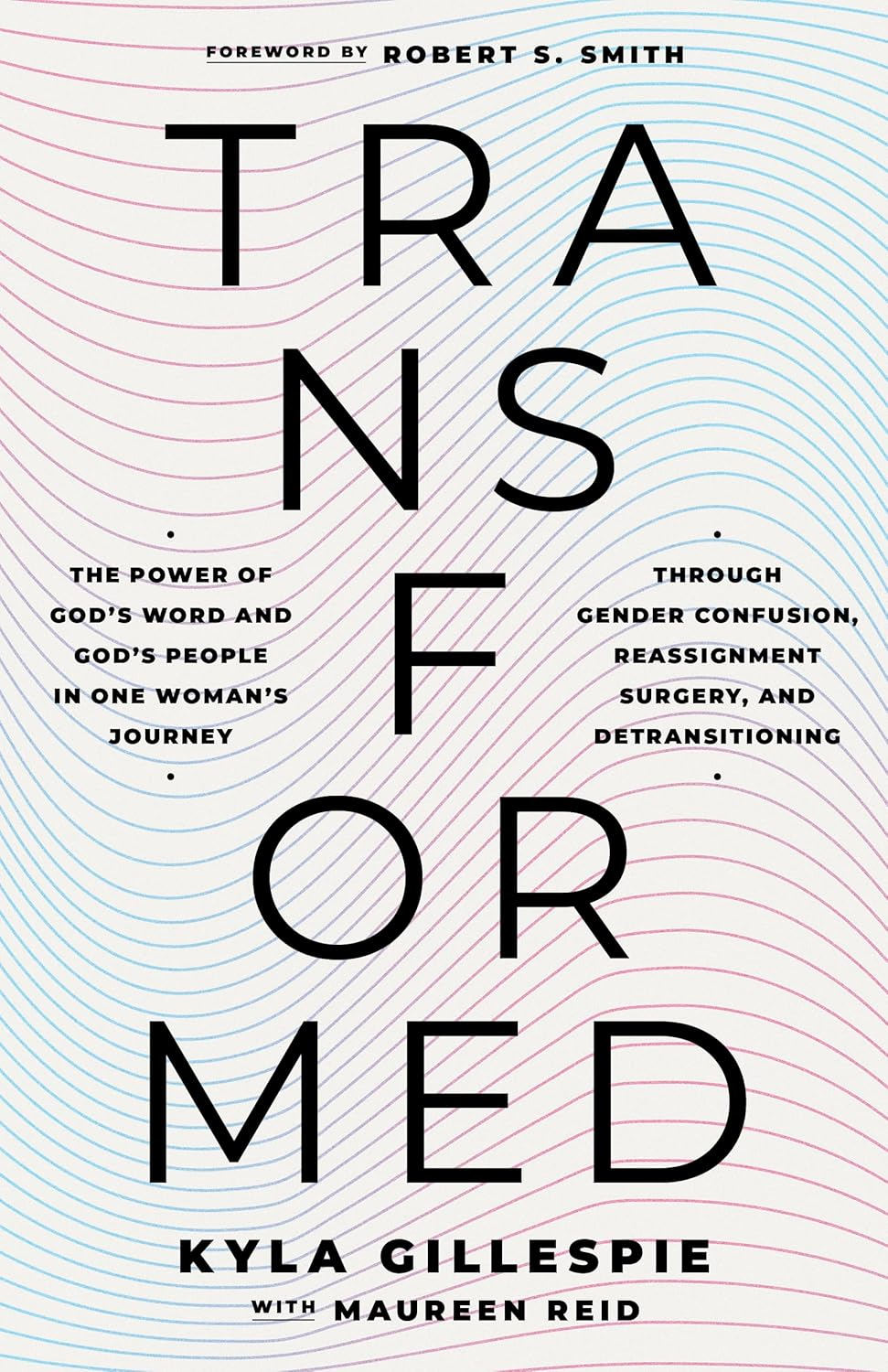
TransFormed: The Power of God's Word and God's People in One Woman's Journey through Gender Confusion, Reassignment Surgery, and Detransitioning
Kyla Gillespie
TransFormed: The Power of God's Word and God's People in One Woman's Journey through Gender Confusion, Reassignment Surgery, and Detransitioning
Kyla Gillespie
But living as a male, even after years of cross-sex hormones and multiple surgeries, did not bring the peace she sought. Nor, for that matter, did the alcohol abuse which grew into full-blown alcoholism. Through a tortuous series of events, she found herself attending a recovery ministry at an evangelical church, trying to get her life back on track, though still living as a man.
That’s when Jess came over and sat beside Brycen, striking up a conversation. Jess, and her husband BJ, befriended Brycen. Their friendship, marked by generous amounts of both grace and truth, became an anchor in Brycen’s chaotic life. Even when they told Brycen things that were hard to hear, she couldn’t deny that they genuinely loved her like no one else in her life had done. They had the aroma of Christ about them.
Encounter with God
Eventually, through the ministry of Jess and BJ, as well as other “Jesus friends” in the church, Brycen had an encounter with Christ that was undeniable and transformative. Confronted by the holiness of God, everything else faded into the background. There were still lots of unanswered questions, but the biggest question was settled: Christ was Lord and God over all.
I found Kyla’s narrative of her gospel transformation powerfully moving. I was struck by the transformative effect of encountering God as the high and holy one. The love of God is important too, don’t get me wrong, but love can more easily be recast in therapeutic terms in a way that God’s sovereignty and holiness cannot. I think of Job’s reaction to God’s revelation of himself,
There is a sobered quietness that comes over a person when they recognize that God is God and they are not. One feels that one is blissfully small, while God is blessedly big.
The Power of the Gospel
But God’s holiness is not enough—it sets the stage for a depth encounter with the costly love of God in the gospel. And this is what Kyla narrates through her raw and honest writing. Here is a precious and confused image bearer of God turning from darkness to light by putting her faith in Christ and his all-sufficient sacrifice on the cross. She writes about discovering that Jesus becomes “our righteousness,” how we “clothe ourselves” in that righteousness, becoming “utterly acceptable to a perfect God” through “the great exchange” (188). This the power of the gospel and the rock-steady hope that it produces in the heart.
Despite this powerful experience, it took some time before Kyla, then still living as Brycen, was convinced that she needed to de-transition and live as the woman God made her to be. The ups and downs of this story remind us that real life with real sinners is messy. Some things change all at once; other things take time. Kyla was simultaneously surrendering her heart and life to Christ while still sufficiently confused and deceived that she was going through with irreversible surgery. Only God can untangle that kind of knotted mess. Your internal contradictions and mine may be less obvious, but if we are honest, each of us is a knotted mess that only God can untangle.
Conviction and Charity
This serves as a powerful reminder that Christians and churches need to have the kind of grace and patience which can deal with the messiness of people’s real lives. Having the right answers on paper is not enough; we need to have the aroma of Christ in the way we engage with each individual. Compassion, far from being compromise, is a prerequisite for earning a hearing. That is, if we are actually interested in helping real people. It’s easier to gain applause from those who already believe as we do by loudly denouncing the lies of the culture. We must be clear about the truth, yes, but we must also speak in such a way that a confused Brycen hearing us will have reason to believe we truly care about them.
This is worth reflecting on for a moment further. We at TGC have staked out a specific posture: the marriage of conviction and charity. Some call this the Carson rule. We strive to be unapologetic about the truth and relentlessly charitable in how we communicate it. Without this tension, we tend to revert into one or the other: acerbic truth-telling or mushy sentimentalism. TransFormed serves as a reminder that holding grace and truth together has a peculiar power, in God’s providence, to soften and change hearts.
Mysterious Sorrow
There were a few moments in the book where the weight of the tragedy on the page sat heavily on my heart. The first was when Kyla’s father abandoned her after marrying a woman who already had a number of children of her own. Rather than find a way to continue being a father to her, he inexplicably cut her out of his new life.
But then there were the surgeries. Without being overly graphic, Kyla walks the reader through both her surgeries: a full hysterectomy and then a double mastectomy. Despite her desperately wanting to have both of these procedures and having no doubts about them, both times she describes the same experience upon waking up: a fountain of grief welling up from some mysterious source deep inside. She describes it as her body itself grieving the loss of those parts of her that most clearly represented her femininity.
Freedom from Gender Ideology
Transgenderism denies a truth that is so basic to the creation order that we almost can’t see it. As Roger Scruton put it, “me and my body are not two things but one.” The separation of the self from the givenness of our bodies is the starting point for gender ideology and transgender medicine. These are not abstract theories, but strongholds of deception that have gripped our society in profound ways.
It grieves me that our Canadian medical system, along with multiple layers of governing and accreditation institutions, is complicit in all this and still under the sway of this pernicious ideology. Canada is a late holdout—country after country has reversed course on transgender medicine (especially for minors). Once again, it seems, Canada is determined to be conspicuous in its embrace of things that dishonour God. May God grant our nation repentance, mercy, and sanity.
In the following passage, Kyla describes the experience of realizing the truth about our created, embodied nature, with all its profound implications for her life.
The human cost of transgender ideology is all too real, and Kyla Gillespie has done us all a great service by honestly chronicling her journey. The mental picture of this precious woman sobbing uncontrollably in a hospital bed after receiving the treatment she was convinced she wanted is one that will stay with me for a long time.
But even more memorable than that tragic scene is the vibrant picture of a woman transformed and redeemed by Christ, with an ardent desire to tell the world—and especially those confused about gender—about what Jesus has done for her and what he can do for them.