




Gender distinctions continue to be at the centre of many ecclesial debates. At the time of writing, the Southern Baptist Convention (SBC) is embroiled in controversy surrounding the appointment of female pastors. At the same time, my own denomination, the Fellowship of Evangelical Baptist Churches in Canada (FEBCC), is considering the same questions. With the lines of these disputes drawn so definitively, can any new perspective offer additional insight? Is there a way to conceive of gendered difference without reducing it to questions of authority and submission? Lyndon Jost’s Transfiguring Headship (Pickwick Publications, 2026) offers a fresh approach.
In this volume, Lyndon Jost—Associate Pastor of Christ Church Toronto (Presbyterian Church in America [PCA]) and Director of the Reformed House of Studies at Wycliffe College (University of Toronto)—retrieves a premodern conception of “headship” through a historical and sociological genealogy of the term. Scripture portrays the “head” as the soteriological representative, a notion that everywhere figures Christ. Whatever it might mean for “the man to be the head of the woman” (1 Cor. 11:3), this relation must be understood in light of the figure of Christ as head and the church as his body.
The Problem at Hand
“Problems with Male Headship” (chapter one) outlines contemporary dismissals of the concept of headship. Any suggestion that a male is the head of a woman not only implies that gender is fixed and binary but also seems to suggest that men naturally are in a position of dominance over women. Jost surveys how “Gender Essentialism,” that is the biological determination of gender, has been challenged by second-wave feminists and post-structuralists. Following Linda Martin Alcoff, Jost suggests something of a “third-way,” called gender realism.
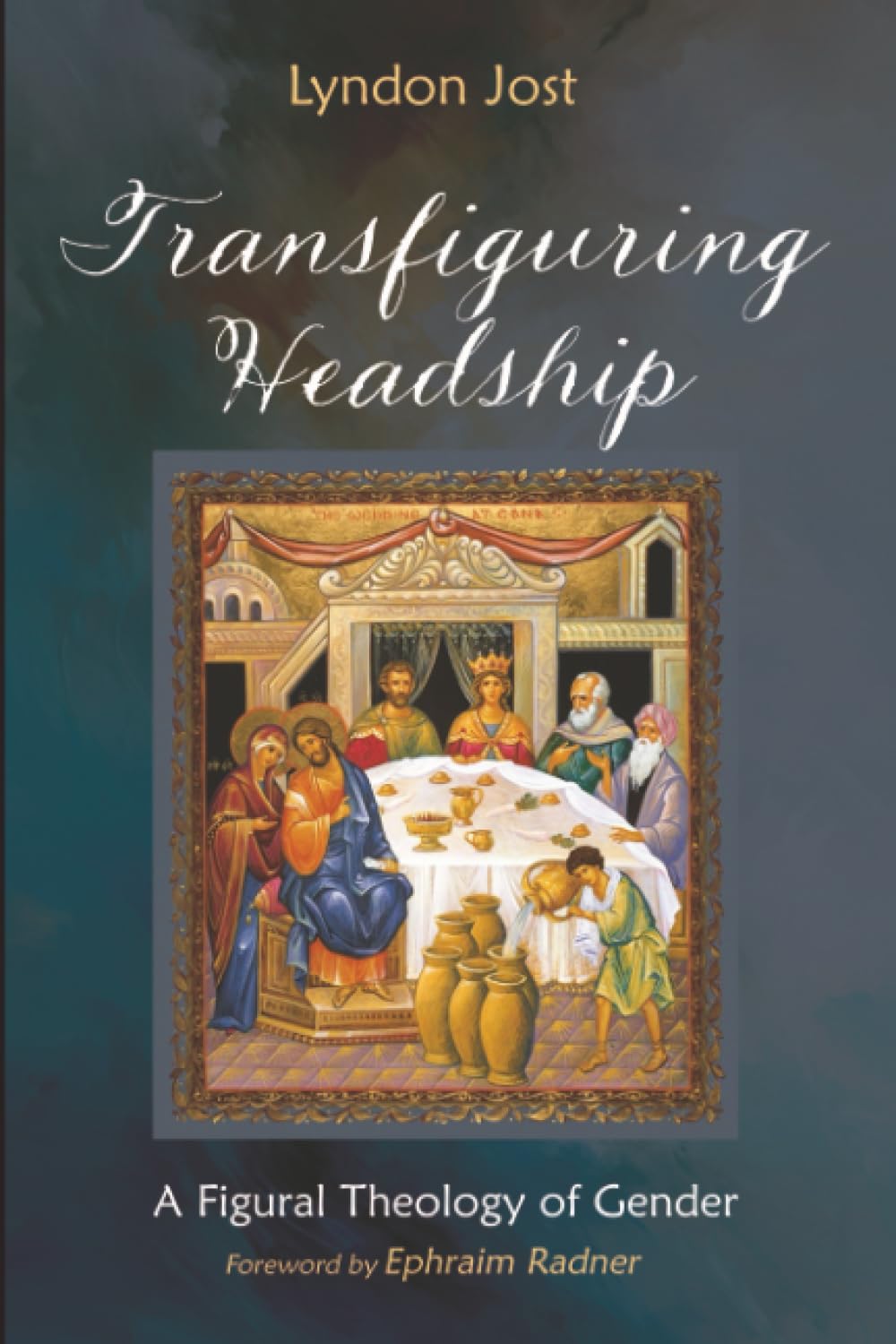
Transfiguring Headship: A Figural Theology of Gender
Lyndon Jost
This view maintains some fundamental aspects of biological differentiation, while insisting gendered expression “emerges in concrete contexts, and so must be defined locally” (25). The gender realist position accords with the story of Scripture, according to Jost, for humans are “irreducibly gendered,” and those genders are “an irreducible duality consisting of male and female” (27, italics original here and throughout).
What Is the Meaning of This?
In chapter two, Jost traces the etymology of the English word “headship” from the Hebrew word for head, rosh. Against the majority of biblical scholars, Jost argues rosh fundamentally denotes representation rather than leadership or chiefdom. The term functions as “a synecdoche for the whole person, the representative member of the body,” that is, the “sum” of the body, in whom the larger one-flesh union is subsumed (50). When ascribed to a family, military, or judiciary, the head is intended to represent the body—a corporate personality—serving its interests.
When the Hebrew rosh is translated into Greek, however, this representative meaning is obscured and reconstrued as rulership. Within the Roman world, rulership was further emphasized in relation to the paterfamilias. Finally, in sixteenth-century England, the term headship is used for the first time, further abstracting and universalizing the concept into a particular position or role without reference to a corresponding body or relation. No longer is the notion of a “head” rooted in complementarity but connotes authority itself.
Where Did We Go wrong?
In chapter three, following his linguistic findings, Jost offers a genealogical study exploring the historical and sociological dimensions of “headship.” Whereas the Hebraic notion of “head” once emphasized representative care, this sense has been lost in modernity. For many, it is simply impossible to conceive of male headship as anything other than female oppression. Jost argues cultural revolutions and the modern conception of the self are behind this development.
Increasingly, gender difference has been replaced by gender sameness in the workplace and in the home. While in pre-industrialized societies headship operates within a dialectic of negotiation between men and women, Jost shows how the Industrial Revolution reshaped the gendered complementarity of household work. Within the new genderless realm of the factory, men and women began doing the same kinds of work. Accordingly, men and women are forced into a competitive, rather than complementary, relationship.
In “Revisionist Heads” (chapter four), Jost explores the rise of gendered sameness alongside the modern conception of the self. Even within the church, there has been an unlikely marriage between the Christian faith and feminist theory. Many revisionist theologians have sought to “depatriarchalize” the Bible with a feminist hermeneutic, attempting to strip away the husk of patriarchalism to maintain some remaining kernel of truth. But for Jost, this theological method imports an “alien claim” that is prone to be “untethered to the message concerning Christ” (86). Whereas this framework fails to remain within the bounds of the Christian story and Nicene Orthodoxy, Jost proposes a modified theological account of gender based on Christ’s headship in relation to his body, the church.
A Way Forward
A theological account of gender is offered in chapters five and six. In “Soteriological Heads,” Jost surveys the figure of head throughout the canon of Scripture. Taking into account the headship of Adam, Noah, Abraham, and even Achan, Jost illustrates the soteriological implications of representative headship. These “heads” serve as figures of salvation for their corresponding bodies—whether families or nations—in a way that typologically relates to Christ. Christ represents his people soteriologically as the head of his body, bride, and of every man.
Constructively, Jost offers Christ’s representative headship on behalf of his people as a scriptural figure of gender differentiation. The union of the head, Christ, and his body, bride, and every man is the divine pattern by which human gender difference corresponds:
Within this framework of gendered difference, the man as head bears final responsibility for the flourishing of the unified body. Jost’s careful exegetical work shows, as Ephesians 5:22 suggests, that the authority of the husband is a self-giving authority “with and for the body” (144). The woman, according to 1 Cor. 11:7–11, is the glory of man who “manifests the glorious splendor of humanity to all of creation, before God and the entire cosmos” (152). If the man is a figure of Christ as head, the woman is a complementary figure of his glorious body.
As Jost concludes, the male head must seek the glory and flourishing of the body he represents, encouraging and empowering her to exercise her talents and abilities. When a head operates according to its role, the body enjoys a fitting measure of freedom, not oppressive limitations.
Transfiguring Headship
This book certainly transfigures modern conceptions of headship. For those who scoff at the idea, Jost warmly welcomes the reader to retrieve its Hebraic representative sense. Male headship is authority with and for the body. For those quite happy with ascriptions of authority and leadership to male heads, Jost’s work is a careful corrective. Headship as male dominance obscures the divine intent behind this Christological figure.
Jost’s work is exemplary in constructing a theology of gender after the story of Scripture and the figure of Christ. Although much of the work deals with matters beyond the text of Scripture—detailing philosophical, sociological, and historical genealogies—his most convincing arguments are made through careful exegesis.
Although this work does not explicitly address the validity of the appointment of female pastors, Jost’s theology of gender is instructive. With Christ’s headship over the church as figure, is there an appropriate application of headship to the office of oversight? Scripture is clear that Christ is the head of the church and that he is so as her husband (Eph. 1:22; Col. 1:18). If headship is a representative responsibility that figures Christ as husband, and the body is a figure of the church as a glorious bride, it seems certain men are to be given this representative responsibility.
To suggest representational headship in the church is an interchangeable role between the genders is to say that the church, like a factory, is a neutered or genderless landscape. But if Christ as husband to his bride is the divine pattern for the church, gendered order is of great significance.
Jost strongly affirms gendered complementarity, but he also endorses the glorious contribution of women in the cause of Christ. For those who find male headship in the church as a given, what role there is for women in the church can be more difficult to answer. Here Jost is instructive. Jesus, as head, invites the whole body together to “share in his ministerial authority” (163). Jesus does not limit the church but nurtures her into the full expression of her glory. And her glory magnifies his own: “Through a male-female head and body duality, God has figured the entire story of salvation, and through it has heralded good news to every creature” (169).