






I’m grateful to be living in a time when “theological retrieval” is a common topic in Christian discussion, when historical theology is considered cool by the bible college students I meet, and when evangelical pastors openly read and quote the early church fathers. Yet I’m less enthused by the way Baptists seem to fit into this growing conversation. In recent years, it feels like hardly a week passes without a Baptist pastor announcing he has become Presbyterian, a Baptist scholar explaining on Substack he has become Anglican, or a young Baptist layperson uploading a 2-hour documentary chronicling their journey into Eastern Orthodoxy. These are interesting times.
As an evangelical Baptist, however, I am not given over to despair. Looking around at the state of theological discourse, I detect both a challenge and an opportunity. The challenge: in a Christian world where ties to antiquity, adherence to tradition, and catholicity are increasingly prized, how can Baptists hold their ground? The opportunity: in a world where theological retrieval and church history are grabbing increased attention, how can Baptists show that our tradition is both historically rooted and theologically compelling? On both points, this is where The Baptist Story: From English Sect to Global Movement proves so valuable.
I was thrilled to recently discover that Anthony L. Chute, Nathan A. Finn, and Michael A. G. Haykin published a second edition of The Baptist Story. While the first edition (2015) remains a perfectly serviceable introduction to Baptist history, this new edition (2025) includes several significant improvements that will be of great interest to those researching, teaching, or evaluating the Baptist tradition. With a reorganization of the structure of the book, a more intentional and consistent contextualization of the Baptist movement within Christianity as a whole, engagement with critical historical and historiographical developments from the last decade, and the addition of further historical details and analysis, this is an edition that serious students of Baptist history will want to pick up, even if they already own the first!
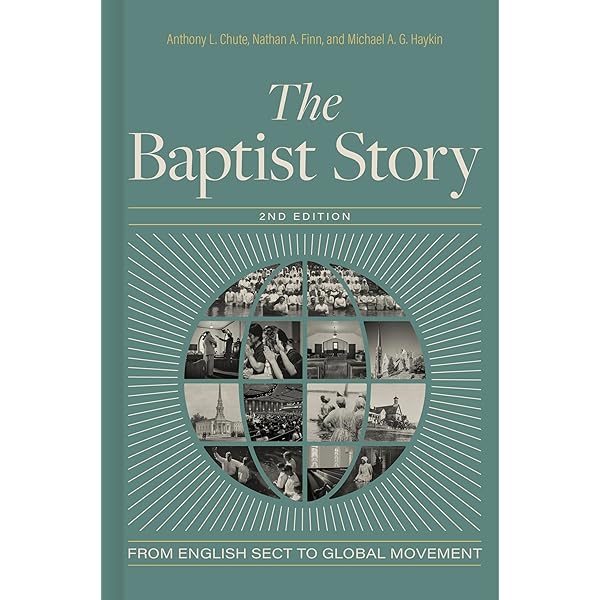
The Baptist Story, 2nd Edition: From English Sect to Global Movement
Dr. Anthony L. Chute, Nathan A. Finn, Michael A. G. Haykin
Purchase on AmazonThe Baptist Story, 2nd Edition: From English Sect to Global Movement
Dr. Anthony L. Chute, Nathan A. Finn, Michael A. G. Haykin
Moreover, for those who might be new to the study of Baptist history, I am totally confident in saying that if you’re getting or reading one book on Baptist history, it needs to be this one. Whether you’re the Baptist pastor trying to learn Baptist history so you can teach it, the Baptist layperson just trying to appreciate why you should remain a Baptist, or the non-Baptist trying to figure out who Baptists are and what they’re about, this book is for you.
While this is a longer book (nearly 500 pages!), it is an all-encompassing one. Working according to their specialties, the authors cover four centuries of Baptist history, from the tradition’s origins as an English sect to the tradition’s present as a global movement: Haykin covers the seventeenth and eighteenth centuries, Chute the nineteenth, and Finn the twentieth century to the present (p. xiii). Yet, this work goes beyond a simple, chronological recounting of historical facts.
A Clear and Historically Grounded Story
The most visible change made between this edition of The Baptist Story and the first was the authors’ decision to move up their chapter on “Baptist Identity and Distinctives” from the end of the book to the beginning. This switch is a helpful change. Now, rather than deductively trying to figure out who Baptists are as you read, you head into the clear vision of whose story the book is telling. Baptists are a movement of Christians who uniquely emphasize (1) Regenerate Church Membership, (2) Believer’s Baptism, (3) Congregational Polity, (4) Local Church Autonomy, and (5) Religious Freedom (pp. 20–37). In a manner more succinct than the popular B.A.P.T.I.S.T.S. acronym, the authors quickly capture the key principles that make Baptists Baptists. Moreover, it is helpful to move from this definition right into the chapter on Baptist origins. By locating Baptist origins in the “Puritan Soil” and “Separatist Roots,” the authors provide a clear image of how Baptists connect to church history as a whole, how Baptist distinctives organically and biblically developed from the English Reformation, and how Baptist distinctives form the core of and reflect a unique spirituality which distinguishes them from other credobaptistic traditions (pp. 47–50). The Baptist Story provides the antidote to any claim that being a Baptist simply means rejecting infant baptism.
An Engaging and True Story
As every preacher and teacher knows, content is only half the battle—you can have the most profound and helpful information to share, but if it is not delivered engagingly, you might as well not waste your time. Thankfully, The Baptist Story delivers both content and style by staying true to its title and telling its readers stories.
While the book gives all the names and dates you would expect from a history textbook (and could certainly be used to great effect as one!), it does not read like a textbook. Readers will delve into the tale of the first Baptist, John Smyth, who came to Baptist convictions, baptized himself, and all to end up joining the Mennonites (pp. 50–53)! You’ll encounter the narratives of Isaac Backus and John Leland, early Baptists who painstakingly led the charge for religious freedom in New England, a principle we now utterly take for granted in the modern West (pp. 139–143). You read the dramatic stories of the “hym-singing controversy” and the so-called “worship wars,” gaining a full picture of historic and recent events that still have direct ramifications for the musical worship of many Baptist churches today (pp. 93–97; 425–428).
In all this, The Baptist Story does not succumb to triumphalism; Baptist history is presented warts and all. For both Baptists and non-Baptists, you will receive a captivating and honest retelling of how Baptists arrived at various theological conclusions and spiritual practices, with all the historical and scriptural evidence included. As a bonus, pictures and primary-source extracts are consistently provided to help visualize and ground events as they unfold in the author’s retelling. Basically, the reader gets all the information of a textbook without feeling like they’re reading one!
An International and Inclusive Story
While it’s an inescapable fact of Baptist history that much of the writing will focus on the work of British and American white men, the authors do not allow that to obscure the many and great contributions of women and Baptists around the world. For example, the amazing theological mind of Anne Dutton is presented and contextualized—a Baptist woman remembered especially for her theologically rich presentation of the spiritual presence of Christ in the Lord’s Supper (pp. 114–115). The stories of great African American Baptist leaders receive careful study, especially that of George Liele, a formerly enslaved African American who ought to be considered the first Baptist missionary (pp. 153–155). The modern spread of the Baptist tradition throughout Asia and Africa, and the foundation of indigenous Baptist associations and institutions, is detailed as well (pp. 460–469).
The Baptist Story doesn’t merely rehash the familiar stories of the great with clarity and dynamism (it certainly does that); it also tells the neglected or forgotten Baptist stories that Christians would benefit from knowing and understanding today. By the end of the book, one will be able to evaluate the Baptist movement as a discernible tradition with core principles and a shared spirituality, while also being given the information to appreciate it as an incredibly diverse tradition spanning numerous countries, cultures, and languages.
Conclusion
Sensing the challenge and opportunity of the current moment, I was grateful when my elders gave me leave to prepare and teach an eight-week class on Baptist history. Thinking back to my seminary days, I remembered how sitting in Dr. Michael Haykin’s Baptist History class not only helped me understand why Baptists believe what we believe and why we do what we do, but also how we relate to church history, other Christian traditions, and the grand story of redemptive history. After faithfully preaching the Word and administering the ordinances, teaching Baptist history is one of the best things a Baptist pastor can do to help his people confidently stand firm in their Baptist identity. After faithfully committing to the life and worship of the local church, learning Baptist history is one of the best things a Baptist layperson can do to understand and appreciate their Baptist identity.
While not everyone will have the opportunity to sit in a Baptist history class with Chute, Finn, or Haykin, many of us can benefit from the next best thing: The Baptist Story. This book offers pastors, seminarians, and laypeople a clear, engaging, historically grounded, and internationally aware introduction to the Baptist tradition. At a time when Baptists might be tempted to look elsewhere for ecclesial stability and non-Baptists might scoff at the idea of theological rootedness among Baptists, this book reminds us that the Baptist story is worth knowing and telling again.