






Sometimes Christians forget how ancient Christianity is. Sure, we all know that Jesus lived, died, and rose again 2,000 years ago, but we forget that for the past 2,000 years there have been Christians worshipping Jesus, thinking about Jesus, living for Jesus, dying for Jesus, and writing about Jesus. The world of the earliest Christians is distant and foreign to us living so much later, but it is a world worth exploring! I would recommend On the Apostolic Preaching by Irenaeus of Lyons as a good starting point. There is a good modern translation of On the Apostolic Preaching in the Popular Patristics series from St. Vladimir’s Seminary Press. It is a short book, 101 pages long (63 pages if you exclude the lengthy introduction by the translator, John Behr), and a fairly straightforward read.
Irenaeus of Lyons
Irenaeus lived in the late second century AD. As a young man, living in Smyrna (now Izmir, in Western Turkey), he was taught by a pastor named Polycarp, who had been taught directly by the apostle John himself! Irenaeus later recounted
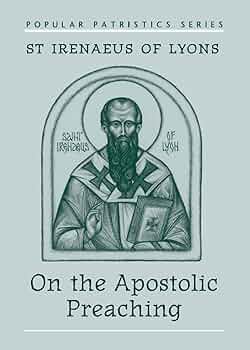
On the Apostolic Preaching
St Irenaeus of Lyons
how [Polycarp] would speak of his familiar [communication] with John, and with the rest of those who had seen the Lord; and how he would call their words to remembrance. Whatsoever things he had heard from them respecting the Lord, both with regard to His miracles and His teaching, Polycarp, having thus received [information] from the eye-witnesses of the Word of life, would recount them all in harmony with the Scriptures.
Irenaeus goes on to say that, “These things, through God’s mercy which was upon me, I then listened to attentively, and treasured them up.” (Fragment II, ANF vol 1, pg 568)
Later in life, Irenaeus moved to the western edge of the Roman Empire to Lugdunum in Gaul (now Lyons, France). He served as a pastor in Lyons for the rest of his life, encouraging his church through times of persecution, evangelizing the Celtic Pagans, and teaching against the Gnostic Heretics.
The Gnostics were a particular emphasis of Irenaeus’ ministry due to their danger to the church. Gnostic teachers were skilled at twisting the Bible to prove their system of faith. They taught that the God of the Bible was not the ultimate, true God, but the lower, evil “god” who created the evil, physical world and that it was unthinkable that the Son of God would become a human. Their deceitful tactics led many Christians astray from the truth. Irenaeus described the way the Gnostics misused the Bible with a helpful analogy:
Their manner of acting is just as if one, when a beautiful image of a king has been constructed by some skilful artist out of precious jewels, should then take this likeness of the man all to pieces, should rearrange the gems, and so fit them together as to make them into the form of a dog or of a fox, and even that but poorly executed (Against Heresies I.viii.1 ANF vol 1, pg 326)
The Apostolic Teaching
One of Irenaeus’ main purposes as a pastor was to help people keep the image of the king in focus when reading the Bible. It isn’t enough just to read the Bible—we must read it the way the apostles taught us to read it. He calls this proper reading of the Bible the “rule of faith.” This rule of faith is confessed at baptism, which we receive “in the name of the Father, and…of Jesus Christ, the Son of God who was incarnate, died, and was raised, and in the Holy Spirit of God” (Apostolic Preaching, 42). On the Apostolic Preaching lays out Irenaeus’ vision for how to keep this rule of faith and read Scripture with the image of the king in focus, which is to say, seeing the God who is Father, Son, and Holy Spirit and the salvation this Triune God brings to us.
The Father
Irenaeus emphasizes biblical truths about the Father that are in contrast to the Gnostic teachings. The Father is the one true supreme God, the maker of all things, and is good (44). Irenaeus continues by outlining salvation history through the story of the Old Testament, showing that for all of fallen creation, the Father is “Judge, for no one shall escape His judgement” (45) but also “Lord and Lawgiver” to the Jews “that they may learn” who he is and “to Him…offer worship by day and by night” (44–45). Finally, “to the faithful, he is as Father, since ‘in the last times’ He opened the testament of the adoption as sons” (44).
Jesus Christ
When Irenaeus speaks of the supremacy of the Father, he is not setting him above the Son. He is very clear that “the Father is Lord and the Son is Lord, and he Father is God and the Son is God, since He who is born of God is God, and in this way, according to His being and power and essence, one God is demonstrated” (71). Father and Son (and Holy Spirit) are each truly God and together are one God.
At the same time, he describes the distinction between the Father and Son in this way: “but according to the economy of our salvation, there is both Father and Son, since the Father of all is invisible and inaccessible to creatures, it is necessary for those who are going to approach God to have access to the Father through the Son” (71). Irenaeus locates the distinction of the members of the Trinity in “the economy of our salvation.” Later church fathers would hammer out the doctrine of the Trinity more precisely, differentiating between the ontology of God—the eternal relations of the Father, Son, and Spirit—and the economy of God—the roles of the Father, Son, and Spirit in relation to us and our salvation. It would not be fair to hold Irenaeus to the standard of this more developed doctrine; nevertheless, he teaches an orthodox understanding of God: the Son is truly God, one with the Father, and yet is distinct from the Father. And the Father sent his Son for our salvation.
Recapitulation
Irenaeus often speaks of the mission of Jesus in our salvation as a mission of “recapitulation.” By recapitulation, Irenaeus means that Jesus came to earth as a human to retell the story of humanity, accomplishing for us what we failed to do.
Irenaeus’ understanding of recapitulation begins with his understanding of how God created us in his image. God “sketched upon the handiwork [that is, upon humans] His own form—in order that what would be seen should be godlike, for man was placed upon the earth fashioned in the image of God” (46). As those made in the image of God, with God’s life and power in us, “man was like God…that he should rule over everything upon earth” (47). But because of sin, humanity was separated from God, who is life, unable to be like God and rule over the world as we should, and subject to death (50).
Jesus answered this fall of humanity when he, “in the last times, to recapitulate all things, became man amongst men, visible and palpable, in order to abolish death, to demonstrate life, and to effect communion between God and man” (43–44). This communion between God and man was only possible because “the Word became flesh.” God took on humanity so he could recapitulate our story. He took on flesh so “that by means of the flesh which sin had mastered and seized and dominated, by this, it might be abolished and no longer be in us” (60). This is why Jesus became like Adam, so that he might “vanquish in Adam that which has struck us in Adam” (61).
Irenaeus spends the bulk of his book tracing through Old Testament passages that point forward to Jesus as the one who would be “revealed to all the world at the close of the age as man, ‘recapitulating all things’ in Himself” (60). These Old Testament passages are the writings of prophets who spoke “by the Holy Spirit” (60).
Holy Spirit
Alongside of Irenaeus’ main focus on the Holy Spirit as the one “through whom the prophets prophesied,” he also speaks of him as the one who, in the last times, was poured out in a new fashion upon the human race renewing man, throughout the world, to God” (44). Because Christians have “the Holy Spirit constantly dwelling in” us, we are able to “keep the body stainless” and “soul uncorrupted” by sin. It is also by the Spirit’s work “that the resurrection comes to believers, the body receiving back again the soul and, together with it, is raised by the power of the Holy Spirit and is led into the Kingdom of God” (67).
Challenges
As Irenaeus reads through the Old Testament, he keeps the image of the king in focus, finding Jesus in passages where a modern Christian might be unlikely to see him. Much of his exegesis is typological in nature, bypassing the historical context of the original readers and seeing Jesus represented thematically in the details of the texts. Many of the passages that Irenaeus deals with will pose no problem, such as when he sees Jesus as the fulfillment of the prophecies of Psalms 45 (71), 110 (72), Isaiah 7 (74–75), Isaiah 9 (76–77), Micah 5 (81), and so on (though even there, some of the details may raise eyebrows). But we may struggle more with how Irenaeus finds Jesus in passages like Psalms 3 (87), 89 (88), Lamentations 4 (85–86), Amos 9 (81), and so on. On top of this, we also have to wrestle with the fact that Irenaeus quotes from the apocryphal book of Baruch (100) and passages of Jeremiah that are not found in any current manuscripts (89, see also note 199).
But before we reject Irenaeus’ exegesis offhand, we must consider a number of points. First, just because Irenaeus sees Jesus in a passage that isn’t about Jesus in its historical context doesn’t mean that Irenaeus is ignoring its historical context. He simply emphasizes the typological themes foreshadowing Jesus. Second, we must remember that every passage of the Bible has two authors: the human author and the divine author. As the Holy Spirit spoke through the human authors, he had a larger picture of Scripture in mind, and so it is possible that he intended a deeper meaning in a passage that the human authors didn’t intend and weren’t aware of.
Third, the methods of interpretation that Irenaeus uses are the same methods that the apostles often use in the New Testament, as they point to Jesus in the Old Testament. If we’re honest, we often find it difficult to understand how the New Testament authors are interpreting Old Testament passages (for example see Matthew 2:15). They even will quote the Septuagint and draw meaning out of the Greek translation that isn’t clear in the Hebrew (for example, see Hebrews 10:5). Of course, Irenaeus was not an apostle, and so his writings do not share the same authority and infallibility that the New Testament does. He inevitably just got it wrong at least some of the time, and so it is within our right to disagree with him. But when we remember that he was taught by Polycarp, who passed John’s teachings down to him, that should motivate us to at least give his interpretation serious consideration.
Conclusion
Even though we may disagree with Irenaeus in places (I certainly do!), there is plenty that is helpful in his book as he shows us how to read the Bible with the picture of the king in focus. We will benefit from the ancient wisdom of this godly pastor who loved the Word of God and the people of God because he loved God the Father, Son, and Holy Spirit.