



While Carl Trueman discourages any direct comparisons to C.S. Lewis and his book The Abolition of Man, it is not hard to see why many do make that comparison. Trueman, in the opinion of this reviewer, is serving the church in a similar way as Lewis did, helping us make sense of the world around us in times of great social upheaval. Christians in every age need to understand how, why, and towards what the culture’s moral intuitions are changing. Trueman borrows the term social imaginary to describe those intuitions. At the root of the change, as Trueman has described in The Rise and Triumph of the Modern Self, is the ascendency of the psychological self. In this new social imaginary, individual feelings are the ultimate arbiter of morality and reality, and authenticity is the greatest virtue.
If you have not yet read The Rise and Triumph of the Modern Self, the good news is that he revisits the main points in The Desecration of Man. This triumph of the self was conceived during the Enlightenment and the birth of modern science. In this new era, natural scientists, no longer content to be limited by the impositions of the natural order, boldly began to unlock creation’s secrets and to use this new knowledge for human flourishing. Eventually, enlightened thinkers—emboldened by great progress—began to think differently about God. We seem to be able to explain everything without God. Does he even exist?
Enter the Madman
Trueman borrows from Friedrich Nietzsche’s “madman” parable to describe the predicament of atheistic modernity. In this memorable episode, a madman runs into a town square of atheists, declaring that “God is dead. God remains dead. And we have killed Him.” He describes the magnitude of such an act as unchaining the earth from the sun. The madman is really the only sane one in the square because he alone realises that without a transcendent anchor such as God, the world will descend into chaos: “Is there still any up or down? Are we not straying, as through an infinite nothing?” And this ensuing moral chaos leads to what Trueman calls the “anthropological crisis” of the modern era, in which transgressing boundaries has become a celebration of authenticity and autonomy.
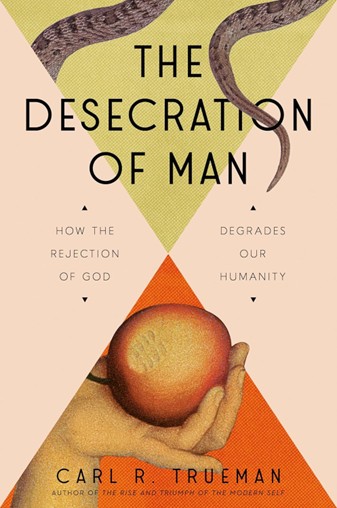
The Desecration of Man
Carl R. Trueman
Let’s get specific. What is the chaotic fruit of this anthropological crisis? Trueman lists a few: transgenderism, transhumanism, and the commodification and objectification of the human body (think here of reproductive technologies, pornography, and the debates over bodily autonomy). Whereas many cultural critics settle on disillusionment, disenchantment, or despair as the worst of the fallout from this collective rejection of God, Trueman says it goes beyond that to desecration. Because the psychological self needs the affirmation of society, a type of warfare must be waged against every old order and every sacred institution that is contrary to the impulses of the individual. Speaking of the need for absolute victory in war, Winston Churchill once said, “Germany must be beaten. Germany must know that she is beaten, must feel that she is beaten.” This seems to be the cry of the triumphant self as it dances on the grave of God and exults in ascending to his throne. As Trueman puts it, “Desecration of all that was once considered holy became a hallmark of that authenticity that expressive individualism craved” (54).
With God out of the picture, humans have had to find ways to transcend our own limitations. Or as the madman puts it, “Is not the greatness of this deed too great for us? Must we ourselves not become gods simply to appear worthy of it?” Whereas God bestows honour and dignity on humanity by creating us with purpose and significance, in this strange new world, humanity is no longer exceptional but rather an evolved beast with no claim to the sacred, no image of God. For many today, and especially cultural creatives and artists, meaning comes from the overthrowing and transgressing of the sacred, which only degrades and desecrates our humanity.
What Should We Do?
What does Trueman suggest the church do in this cultural moment? Those who have read Trueman’s Crisis of Confidence, whose subtitle reads: Reclaiming the Historic Faith in a Culture Consumed with Individualism and identity, will recognise that the solution is for society, or at least the church, to return to “re-consecration.” We do this by cherishing our Creeds (orthodox biblical doctrine), participating in our Cult (public worship), and practicing our Codes (moral/ethical teaching). It is worth noting here that Trueman recognises the trend among certain atheists like Richard Dawkins, and to some extent Tom Holland, toward a form of cultural Christianity. He warns us not to be unduly encouraged by this because the blessings of Christianity cannot ultimately be separated from its Creed, which includes a whole host of specific doctrinal and historical claims. Dawkins and Holland cannot bring themselves to accept these truths, but they want to enjoy the benefits of a civilization shaped by Christianity.
Anything from the pen of Carl Trueman is worth your time. The reader of this book will gain valuable insights into the chaos and craziness of our times and be better equipped to diagnose and treat the wounded in the spiritual warfare that rages around us. It will also guide us in recommitting our hearts to cherish the life-giving truths of God’s Word for our own welfare and for the glory of God.