









Let’s begin with a little self-reflection. Have you ever disagreed with someone? Have you ever handled a disagreement poorly? Everyone’s hand should be up by now, so let me ask one more question. What would you give for disagreement to deepen friendship instead of destroying it?
Whether it’s with your spouse, your kids, co-workers, or that frustrating member of your church (which might just be you), no one can avoid disagreement. And we can all grow in the art of disagreement. Gavin Ortlund has written a short and useful book, The Art of Disagreeing: How to Keep Calm and Stay Friends in Hard Conversations, for such a purpose.
In the introductory chapter, Ortlund writes, “Handled well, our disagreements can be both enjoyable and productive. They can deepen our relationships rather than destroy them- and can deepen us along the way” (p. 11). Yes, disagreement done well can deepen friendship when kindness and courage are applied in the practices of listening and persuasion, all clothed in love for God and neighbour, govern how we disagree. We will look at each of these contours in Ortlund’s plea, finishing with some points of reflection.
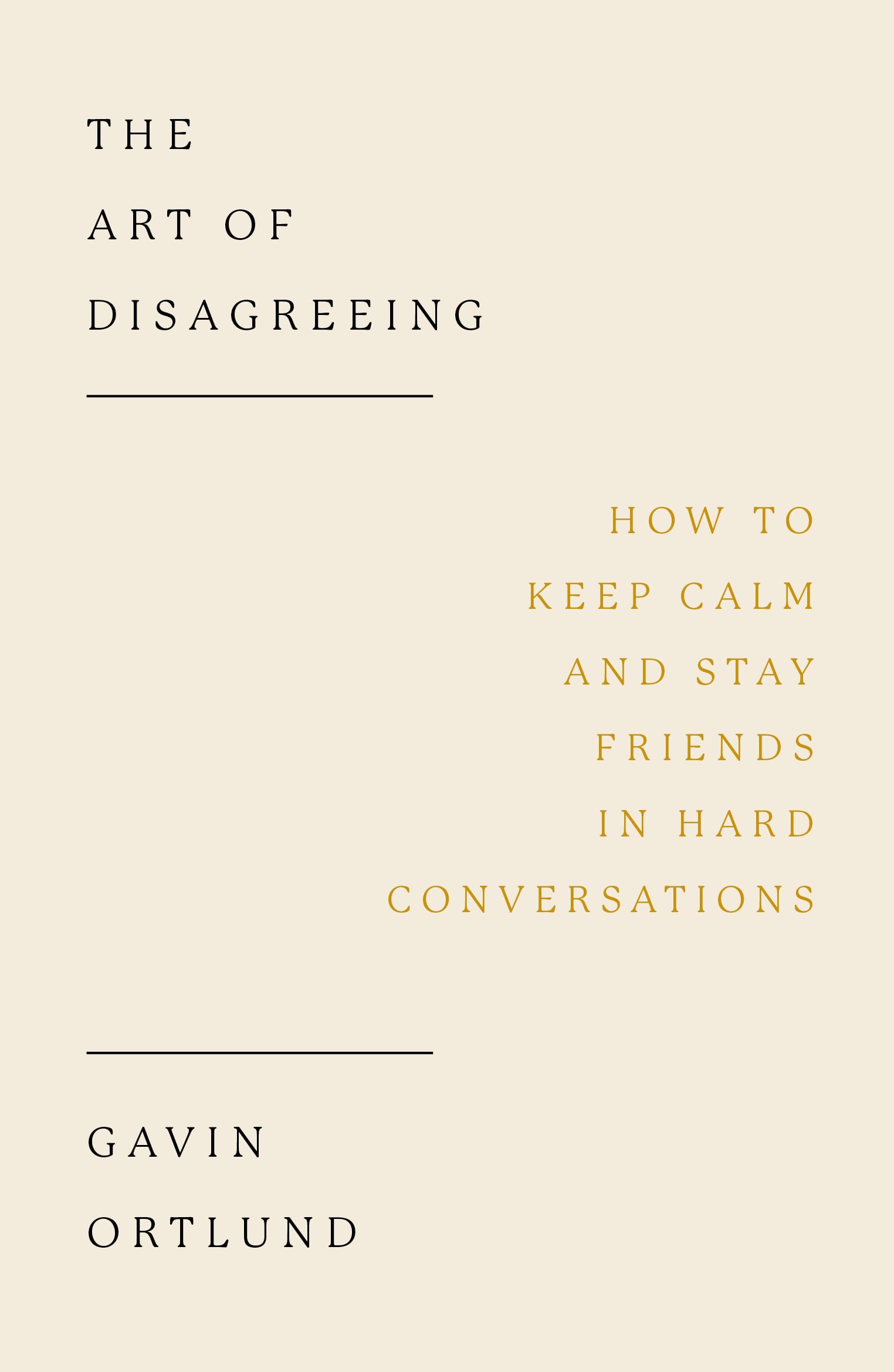
The Art of Disagreeing: How to Keep Calm and Stay Friends in Hard Conversations
Gavin Ortlund
The Art of Disagreeing: How to Keep Calm and Stay Friends in Hard Conversations
Gavin Ortlund
Virtues: Kindness and Courage
Ortlund emphasizes kindness and courage as two essential virtues in the art of disagreement.
Kindness is essential for loving the person we disagree with and knowing what hills are worth dying on. Kindness, after all, is a fruit of the Spirit and a calling over all Christian conduct (see Eph 4:32). Ortlund says, “Ultimately we must recognize that for Christians, kindness is not merely a strategy but a matter of obedience to the New Testament” (p. 29).
Ideas don’t simply float through the air awaiting a takedown by a killer thread on X. Disagreement happens in flesh and blood, with another person made in the image of God. Kindness controls our conduct, keeping us from handling disagreement like a wrecking ball. Treating people with kindness is not unconditional acceptance. Kindness is treating people as God in Christ treats us (Eph 4:32 & Titus 3:5).
Ortlund pairs kindness with the virtue of courage. What does courage look like? On the doorstep of Canaan, God told Joshua, “Be strong and courageous” (Josh 1:9). The land is not safe. The same dangers that made Israel turn and run a generation prior are still there. But God calls Joshua to go and lead with courage. Courage is persevering in the good with a trembling hand and a twisting stomach.
Courage, Ortlund explains, is both vulnerable and bold. Difficult conversations about disagreements can be costly. But courage means being brave enough to love what is good, true, and beautiful and to hold your ground, especially when the cost is high. What does this look like for you? “Maybe it will look like broaching that uncomfortable topic you’ve been avoiding. Maybe it will involve revisiting a prior conversation where you caved in, to clarify your view and move the conversation forward. Maybe it will require holding the line against a bully or a troubled person who wants to guilt you into submission” (p. 47). Whatever it may be, God calls you to face difficult disagreements with “joyful courage.”
Kindness and courage are both necessary. Courage without kindness can make us unfeeling, blunt instruments. Kindness without courage can give too much ground when confronted by disagreement. Jesus is the ultimate model of kind courage, loving his enemies while never giving an inch to the Pharisees. These two virtues are essential for speaking the truth in love.
Practices: Listening and Persuasion
Listening and persuasion are practices that apply the virtues of kindness and courage in disagreement. Listening is how we understand the other person. Listening, Ortlund says, “is an active, responsive discipline” (p. 54). It is not simply waiting for our turn to speak, but attentive engagement for the sake of understanding. Only a fool speaks without understanding, and disagreement makes a fool of many.
Becoming better listeners is how we grow in understanding. By practicing good listening, we better understand the views we disagree with and also the person who holds those views. Ortlund provides practices and prayers to help readers grow as better listeners who patiently ask lots of clarifying questions and love others enough to understand them well.
Persuasion is how we make the case for our view. Done well, Ortlund says, persuasion is an act of love. “God has given you unique insights and experiences, and if you don’t share them, you may be depriving others around you of what God wants to teach them through you” (p. 69). It is good and biblical to value persuasion (Pro 16:23), but it is difficult. Therefore, Ortlund provides a reasonable pathway for doing this by building trust, accurately naming the disagreement, steel-manning the other person’s view, and more (pp. 71–85).
A key point Ortlund makes is about the necessity of making arguments. What is self-evident to us often isn’t self-evident to others. Rather than allowing this to lead to bitterness and frustration, Ortlund says, it should force us to make better and clearer arguments for our position (pp. 82–84). Arguments are not bad. Good arguments bring clarity and calmness to a disagreement. “In the heat of disagreement,” Ortlund says, “logic is calming” (p. 83; italics original). Lower the temperature with the calming clarity of good logic.
An Appeal to Love
Nothing in this book makes disagreement disappear. That’s not Ortlund’s aim. This side of heaven, we will live with some level of disagreement, and therefore, we need tools and virtues to disagree well. Chief among them is love. Ortlund states, “Disagreement itself is not the problem. But what grieves me these days is the way we conduct our disagreements: without any sense of love for one another” (p. 89; italics original). I share this grief. Disagreement is often tinged by pain, misunderstanding, and mischaracterization of other people and positions. But it doesn’t have to be this way. There are points of doctrine and morality that Christians must never budge on. But Christ-like love must always season our disagreement. Ortlund lays out his desire when he says, “Love is the essential key to everything else we’ve worked through in this book.… The art of disagreement rests on the presence of real love” (pp. 92–93). A lack of love discredits the gospel (John 13 & 17). It reminds me that Paul was not surprised to find divisions among the Corinthians but was perplexed by their lack of love (1 Cor 11:18-19 & 13:1-14).
Practicing the Art
It can feel like the stakes around most disagreements today are an Avengers-level threat. The fate of the world feels at stake. Reality is much different. We all live in relationships textured by disagreement. Marriage, parenting, friendship, and church membership are never disagreement-free relationships. The morning after I do something dumb, my wife will wake up and see my face. We cannot snap away disagreement or wiggle our nose and get a do-over. We live and learn in the fallout of poor choice of words, hurt friendships, and differing convictions. The world is not at stake, but something valuable can be lost or gained by how we handle such disagreements. Ortlund’s book can help us lower the temperature around disagreement and live out Jesus’s call to “love your enemies and pray for those who persecute you” (Matt 5:44).
Ortlund’s pastoral tone shines in this book as he notes the crucial difference between having a tough conversation with a friend and confronting abuse (p. 65). Some relationships simply need to end. While offering some counsel about when avoidance is necessary (p. 32), Ortlund carefully and wisely qualifies the parts of the book where he is not speaking to victims of abuse.
When done well, disagreement teaches and deepens us. Disagreement doesn’t have to destroy friendship. When done well, it strengthens friendships. May we learn to disagree well and sharpen one another as iron sharpens iron. The Art of Disagreeing can help us get there.