





The announcement that Greta Gerwig has cast Meryl Streep to provide the voice of Aslan in the upcoming film adaptation of The Magician’s Nephew has generated no small amount of controversy.
Not surprisingly, heated discussions are running on religious, cultural, and ethical lines. There are also conversations about artistic integrity, fairness, limitations in appropriating and adapting literature, and honouring the original intention of authors. This controversy is not likely to dissipate any time soon and will probably reach a peak of intensity once the movie is released early in 2027.
Before this happens, it is worth considering how C.S. Lewis depicts the voice of Aslan in The Chronicles of Narnia. When we read The Chronicles closely, we find that Aslan’s voice is intentionally presented in specific ways. A faithful representation of Aslan’s voice would have to conform to Lewis’s own imaginative vision of the great Lion.
While giving allowance for contemporary artistic adaptation, Aslan’s voice is not an inconsequential part of his character in Lewis’s literary portrait, and respect needs to be accorded to Lewis’s original creation. This is especially relevant for The Magician’s Nephew, since that book highlights and emphasizes the voice of Aslan more than any other Narnian story.
His Voice is Deep
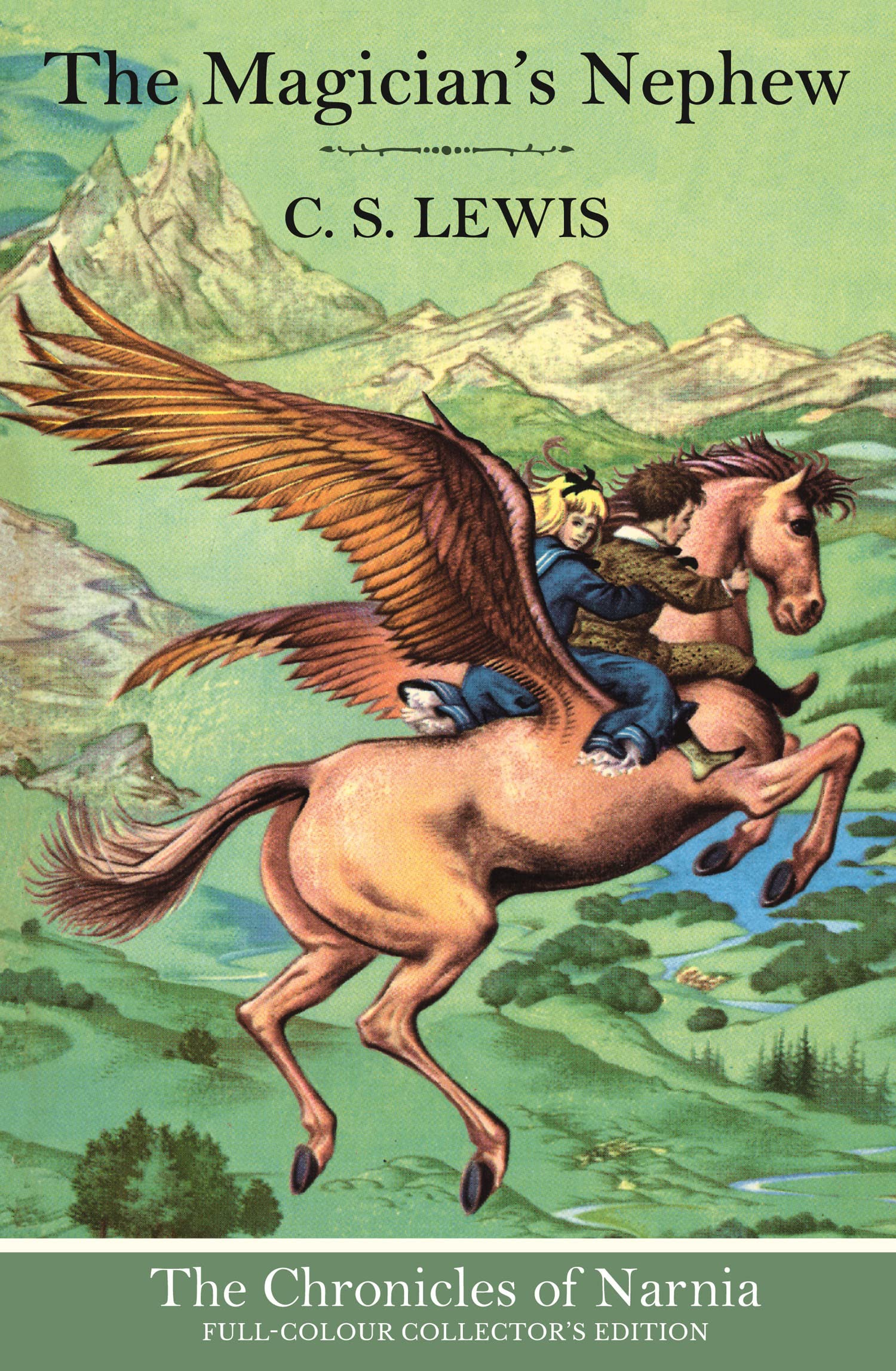
The Magician’s Nephew (MN) was written years after Lewis published The Lion, the Witch and the Wardrobe (LWW). It is a prequel, and therefore the events it depicts occur before the events of LWW chronologically, but the first characterizations of Aslan that Lewis ever wrote are found in LWW. This is important because in LWW Lewis creates the first impressions and draws the first sketches of his main characters. When it comes to Aslan, the very first time Aslan speaks, Lewis informs the reader that “[his] voice was deep and rich” (LWW, chapter 12).1 The first adjective that Lewis ever used to describe the voice of Aslan is deep. In The Magician’s Nephew, before any of the characters see Aslan, they hear his voice singing creation into being, an intentional artistic depiction of what we find in Genesis 1, John 1, Colossians 1, and Hebrews 1.
As the narrator, Lewis even capitalizes “the Voice”. As Aslan sings, the “lower notes were deep enough to be the voice of the earth herself” (MN, 8). Aslan’s voice is “the deepest, wildest voice they had ever heard” (MN, 9). At the end of the book, Aslan is speaking in his normal voice, and it is characterized as “the deep voice of Aslan” (MN, 14).
There are times when Aslan speaks quietly, and in those times his “voice was not loud, but very large and deep” (The Horse and His Boy [HB], 11). When Jill Pole meets Aslan in The Silver Chair (SC), his voice is impressively textured: “…the voice was not like a man’s. It was deeper, wilder, and stronger; a sort of heavy, golden voice” (SC, 2). At the end of the book, when Aslan addresses Jill again, he speaks normally and Lewis describes it again as a “deep voice” (SC, 16; also Prince Caspian [PC], 11).
With all due respect to the voice talents of Liam Neeson and James Earl Jones, Lewis describes Aslan’s voice in such a way that no human being can capture it completely. Aslan’s voice is the deep voice of the great Lion, the Son of the Emperor beyond the Sea. It is deeper, wilder, and stronger than the voice of any human being.
His Voice is Powerful
As cited in the previous paragraph, Lewis describes Aslan’s voice as deeper and stronger than any man’s. Aslan’s voice is described as strong or powerful in multiple places (e.g., MN, 10). Aslan does not need to be loud to express power; he can summon people into new worlds by uttering “a long, single note; not very loud, but full of power” (MN, 11). When Aslan roars, his voice shakes the ground (MN, 12), but there are also times when the ground shakes when he simply speaks (MN, 14). Speaking and roaring are not identical, but the roar of Aslan is so powerful that the White Witch cannot endure it and flees from his presence (LWW, 13).
After his resurrection, Aslan roars in such a way that Susan and Lucy see “all the trees in front of him bend before the blast of his roaring as grass bends in the meadow before the wind” (LWW, 15). When Aslan defeats the Witch in battle, his roar “shook all Narnia from the western lamppost to the shores of the eastern sea” (LWW, 16). Lewis describes one of Aslan’s roars in the following way: “The sound, deep and throbbing at first like an organ beginning on a low note, rose and became louder, and then far louder again, till the earth and air were shaking with it” (PC, 11).
His Voice is Textured and Emotional
When Aslan is singing Narnia into existence, as his song develops, he sings a tune that is “softer and more lilting than the song by which he had called up the stars and the sun; a gentle, rippling music” (MN, 9). As a perfect singer, Aslan uses his vocal range, singing “a series of deep, prolonged notes” and then “a rapid series of lighter notes” (MN, 9). Aslan’s voice can be happy (MN, 10), joyous (LWW, 16), quiet (HB, 15), and gentle (SC, 2). He can roar, but he can also speak in a voice that is “almost in a whisper” (MN, 14).
The song that Aslan sings increases in beauty as he continues to shape and form the world of Narnia (MN, 10). Aslan’s voice is naturally deep, but he has a significant vocal range; he can use his voice to terrify (LWW, 13) but also to calm (LWW, 12). His voice is powerful, rich, and beautiful.
His Voice is Contextually Revelatory
By saying that Aslan’s voice is contextual, I mean that his voice is calibrated to the aspects of himself that he is revealing. The following exchange is one of the most profound and memorable in all the stories:
“Who are you?” asked Shasta.
“Myself,” said the Voice, very deep and low so that the earth shook: and again “Myself,” loud and clear and gay: and then the third time “Myself,” whispered so softly you could hardly hear it, and yet it seemed to come from all round you as if the leaves rustled with it. (HB, 11)
In this passage Lewis is combining the revelation of Yahweh’s name (i.e., I AM, or Myself) with the three persons of the Trinity (i.e., there is one “Myself” but the three voices represent the Christian doctrine of the three divine persons who share the one divine nature). In order for Lewis to represent YHWH and the Trinity, he has the singular Voice speak in three distinct tones.
At the end of The Voyage of the Dawn Treader (VDT), Lewis depicts a scene on the shore at the very end of the world where Aslan first appears as a lamb before transforming into a lion. The entire scene is modelled on the ending of John’s Gospel, where Jesus meets his disciples and has breakfast waiting for them. Lewis writes that the lamb speaks in “a sweet milky voice” (VDT, 16).
In this portrait Lewis is presenting Jesus as the Lamb of God; Christ is the lion and the lamb, and thus Aslan the Lion can be a lamb as well. The “sweet milky voice” is calibrated to the lamb, but when Aslan speaks as a lion his voice does not have that texture or quality. In Narnia the incarnate form that the Son takes is that of a lion, and when he speaks as a lion his voice has the deep, rich, and powerful characteristics described above.
His Voice Matters
Having examined some of the key passages from The Chronicles, it should be obvious that Aslan’s voice is not irrelevant to his character. Any depiction that is faithful to Lewis’s characterization and presentation of Aslan will seek to maintain the voice of the Lion as described in the books. Lewis intentionally matches the qualities of Aslan’s voice with the attributes the stories ascribe to him.
For example, the following passage from The Magician’s Nephew is a key text for seeing the coherence between the tenor of the Voice and Lewis’s first descriptive appearance of the Singer. Lewis writes that everything that was being created
…made you feel excited; until you saw the Singer himself, and then you forgot everything else.
It was a Lion. Huge, shaggy, and bright… (MN, 8)
This vision of Aslan is vital for establishing his nature; it is the first visual impression Lewis makes on his reader concerning the great Lion. If Aslan is depicted without having a deep, rich, powerful voice and a matching appearance that is huge, shaggy, and bright, then he is not the Aslan of The Chronicles.
Both the vocal and physical characteristics of Aslan are significant and evocative, and they cannot be changed without fundamentally altering his character and Lewis’s intentional symbolism. Aslan’s voice, mane, and other physical features are not window-dressing details—they are an important part of Aslan’s character and significant for the holistic integrity of Lewis’s presentation.
In this regard, the Renaissance imperative of ad fontes (back to the sources) is a helpful reminder. There is simply no substitute for reading and rereading Lewis’s own writing, and when we do, we can find the true voice of Aslan.
1 There are so many editions of The Chronicles that citing page numbers can sometimes be of little practical value. I will be following the convention of using an obvious shortform for the book title, and then the number corresponds to the chapter number in which the material is located.