





To find previous articles in this series, click here.
I love great stories that surprise me and make me think. The best stories are the ones that I want to read or watch again as soon as I finish them because the end makes me realize that there were secrets hidden in the story that I didn’t catch the first time. The Bible is a story like that.
In the 1800s, a Russian playwright named Anton Chekhov (not the guy from Star Trek—that’s Pavel Chekov) had a rule when he was writing stories: each element of your story should be important. If you introduce a firearm in the first act of the play, it needs to be used by the third act. This literary rule, “Chekhov’s gun” is why you can know for sure that the gadgets introduced at the beginning of the James Bond movie will be used by the end.
But a good story finds ways to do this more subtly so you can’t predict what’s going to happen. One of my favourite examples of this is in Pixar’s superhero movie, The Incredibles. Towards the beginning of the movie, eccentric costume designer Edna Mode rants that super hero costumes should not have capes. At the end, the villain of the movie, Syndrome, meets his doom because he does have a cape.
An even better example is found in the Bible. In the early pages of the Bible, there is a hint of what is to come. When Adam chose to disobey God, the whole world was cursed. But in the midst of that curse, God also embedded a hint of hope:
And I will put enmity
between you and the woman,
and between your offspring and hers;
he will crush your head,
and you will strike his heel. (Gen. 3:15 NIV here and throughout)
What is the hint? What is Chekhov’s gun? A child will be born to a woman. God planned to save the world through childbirth. This hint is not forgotten as we continue through the story of the Bible—it reappears in almost every book of the Old Testament: in every genealogy that you may be tempted to skip or skim, in every generation of God’s people, in every story of an infertile woman who is granted a miraculous birth. Each and every appearance of the word child, son, birth, generation, descendant, and so on keeps the hint of God’s promised salvation in front of our eyes until it bears incredible fruit in the first pages of the New Testament.
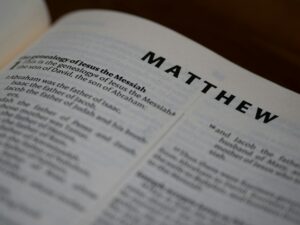
The New Testament opens with another genealogy, summarizing the history of what God had done to that point in the world and reminding us of the hinted promise given all the way back in the beginning. The genealogy ends in verse 16: “and Mary was the mother of Jesus who is called the Messiah.” At long last, the promise was fulfiled. Chekhov’s gun had fired. God’s plan to save the world was finally moving from promise to fulfilment.
As we continue reading the story, we find that this climactic birth was far from ordinary because Mary was a virgin. Of all the miraculous births that had led up to this, this was by far the most miraculous. Mary’s son “was conceived in her… from the Holy Spirit” (Matt. 1:20).
This monumental moment in God’s redemptive history of the world is captured in the Apostles’ Creed with the sentence, “I believe in Jesus Christ…who was conceived by the Holy Spirit and born of the Virgin Mary.” The virgin birth of Jesus is probably the Christian doctrine that our neighbours are most familiar with due to its prominence in Christmas celebrations. But it is also one of the first doctrines to be doubted and rejected even by professing Christians. Could a virgin really conceive? It seems like a fairy tale. And yet, it is a central doctrine of the Christian faith.
The Second Adam
Adam was given a weighty responsibility as the representative of the entire human race that would come from him and the steward of God’s creation. But because he disobeyed God, he brought a curse on humanity and all of creation (Rom. 5:12, 15). The hope that God hinted at in Genesis 3 is that another man would come, born of a woman, and be a better representative for the human race. This second Adam would succeed where Adam had failed and offer perfect human obedience to God, crushing the head of the serpent even as he would be also struck down. In order to do this, he would need to be truly human.
This is why Jesus was not only born of Mary, but truly conceived in her. Jesus was not just a divine being who appeared to be human, using Mary as a conduit into the physical world, “just as water flows through a tube,” as the ancient Gnostics believed.1
Rather, Jesus was truly Mary’s son. He was genetically related to her and so it is safe to assume that he looked like her and inherited some of her mannerisms. If this were not so, then he would not truly be one of us, able to stand in our place as the representative of the new human race and offer his perfect obedience to God his Father on our behalf. What a glorious Saviour the Lord Jesus Christ is!
Truly God
At the same time, however, Jesus must be more than a mere man or he would not have been able to fulfil his mission and save us. No human in history has been able to obey God perfectly (Rom. 3:10–11). What’s more, not even a hypothetically perfect human could stand between a holy God and sinful humanity and act as our mediator and ransom (1 Tim. 2:5–6). In order to fulfill his mission, Jesus must be truly man and truly God.
This is why Jesus was not only conceived in and born of Mary, but was “conceived by the Holy Spirit and born of the Virgin Mary.” Jesus is truly a man, but he is not merely a man. His conception and birth was not like that of any other human, it was a miraculous act of the Triune God.
It is important as we consider the incarnation of Jesus to realize that the conception and birth of Jesus was a unified act of the Father, Son, and Holy Spirit, just like all of God’s acts towards his creation. In the incarnation, God the Father sent his Son (Gal. 4:4) through the life-giving work of his Holy Spirit who worked in Mary to miraculously create new life.
And so he who was with God and was God in the beginning (John 1:1), the one who is “in very nature God” (Phil. 2:6), “the radiance of God’s glory and the exact representation of his being” was the one through whom the Father “made the universe” and “who sustains all things by his powerful word” (Heb. 1:2–3). God the Son, the Word of God, “became flesh and made his dwelling among us” (John 1:14). What a glorious Saviour the Lord Jesus Christ is!
Two Natures
But how does God become a human? Did God change? Did the Father and Spirit take on the Son’s divine responsibilities for 33 years while the Son lived a human life? These are deep questions, but since the Bible teaches that God does not and, indeed, cannot change (Mal. 3:6; Jas. 1:17; Heb. 13:8) we can be sure that God the Son became a human without ceasing to be God. He did not become human by subtracting from his divine nature, but by adding a human nature.
The early church father Athanasius of Alexandria wrote:
Or, as John Calvin later put it,
In other words, Jesus, the perfect God-man really and truly was and is God and human at the same time. God the Son, through his divine nature, is and does all the things that God is and does. And through his human nature, he is and does all the things that humans do. So Jesus is omniscient according to his divine nature (Isa. 46:9-10) and limited in his knowledge according to his human nature (Luke 8:45). Jesus is all-wise according to his divine nature (Rom. 11:33-34; 1 Cor. 1:24) and needed to grow in wisdom according to his human nature (Luke 2:52). This truth is mind boggling; what a glorious Saviour the Lord Jesus Christ is!
We will not be able to understand these mysteries fully, but we can and should believe that they are true. The best explanation of the incarnation produced by the church is the Chalcedonian Definition from AD 451. This is how they put it:
As the perfect God-man, Jesus was able to fulfil his mission as the second Adam and stand in our place, redeeming fallen humanity and bringing salvation to all who trust in him.
The promise that God hinted in the very first pages of the Bible—the biblical “Chekhov’s gun”—has been fulfiled. God the Son, who is eternally God and cannot be limited, took on a human nature when he was conceived by the Holy Spirit in the Virgin Mary and through that human nature, he lived a perfect human life, facing human temptations and offering human obedience to his Father through the power of the Holy Spirit.
I believe in Jesus Christ…who was conceived by the Holy Spirit and born of the Virgin Mary. What a glorious Saviour the Lord Jesus Christ is!
1 Irenaeus of Lyons, Against Heresies, 1.7.2.
2 Athanasius of Alexandria, On the Incarnation, 3.17.
3 John Calvin, Institutes of the Christian Religion, 2.13.4.