






The cloud of witnesses from church history are role models who help us “run with endurance the race that lies before us” (Heb 12:1). For me personally, the life and writings of ordinary yet remarkable Christians have been a well of refreshment and nourishment. The 18th Century, for example, furnishes us with several godly role models, including the evangelistic zeal of George Whitefield and John Wesley; the theological precision of John Gill; the God-centeredness of Jonathan Edwards; and the warm pastoral and fatherly wisdom in the letters of John Newton.
Sometimes, however, for people not in pastoral ministry or missions work, identifying with the names listed above is challenging. Sometimes, people need a role model who sat in front of the pulpit rather than stood behind it. Anne Dutton is such a person. Dutton is a worthy role model for any Christian, especially for women in the church longing for a biblically rich, theologically deep walk with God.
Who is Anne Dutton?
Anne Dutton was a contemporary of Whitefield and Wesley. Converted at thirteen, she was twice widowed and never had any children. Her second husband, Benjamin Dutton, pastored the Baptist church in Great Gransden from 1732 until his death in 1747. Although she had no children, she saw her books as her children and her writing as a way of glorifying God by serving believers. Some of Anne Dutton’s most influential works date from 1747 until her death in 1765.
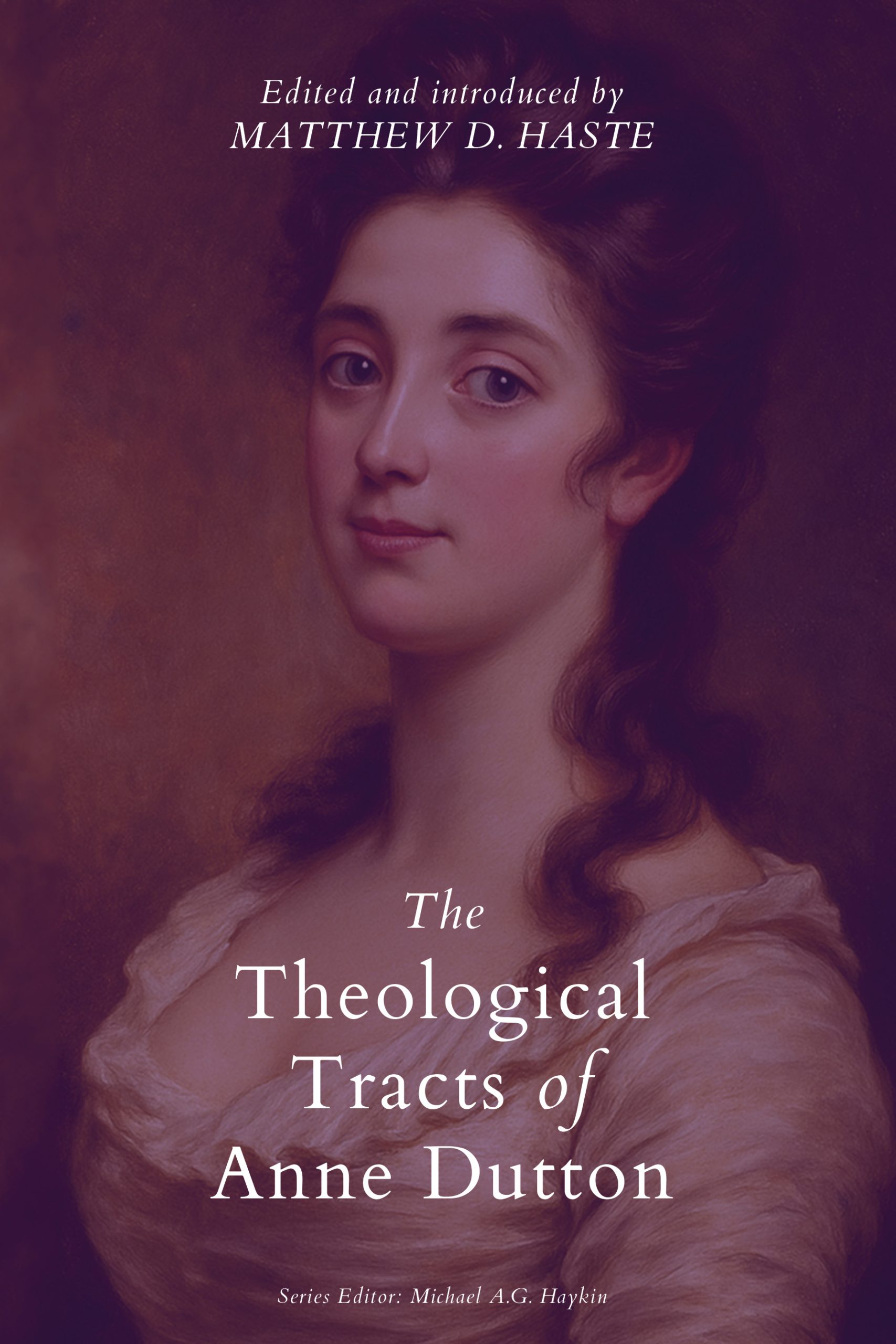
The Theological Tracts of Anne Dutton
Anne Dutton
At a time when it was not in vogue for women to write published works, particularly on theology, Dutton authored several theological books along with scores of theologically rich letters. She had her critics, but she was also deeply respected and a trusted spiritual guide by prominent evangelical leaders like Whitfield, who said of Dutton, “I would have your correspondence enlarged, and therefore I set other people writing to you.” She proved to be a sharp, godly, and capable theological writer.
A Theologian & Churchwoman
“The Theological Tracts of Anne Dutton” is the second volume in The Anne Dutton Project series published by H&E, edited and introduced by Matthew Haste. This volume contains excerpts from some of Dutton’s significant books on Christian doctrine and a sample of her correspondence. The reader will be introduced to her theology of election, justification, adoption, and the new birth. Readers will notice Dutton’s consistency with the evangelical Calvinism of the 18th Century, but will also wrestle with some curious paradoxes in her views.
For example, Dutton affirmed the doctrine of eternal justification. The doctrine of justification, Dutton wrote, can be considered both eternally and temporally. She says, “As immanent, or an act of God’s will that always abideth the same in his divine mind, from eternity to eternity” (p. 91). Flowing from this justification can then “be considered as transient, or as it is an act of God, that passeth upon the creature in time” (p. 91). God’s elect are reckoned justified eternally in the mind of God, and the atoning work of Christ received by faith is the fulfillment of God’s immanent act in time. The ground of justification is not receiving and resting on Christ by faith, but in the assurance of our being elect.
Whitfield shared Dutton’s Calvinism regarding election and particular redemption but differed from her on justification. A person cannot be justified, Whitfield said, until they lay hold of Christ by faith (Sermon “The Righteousness of Christ, an Everlasting Righteousness”).
The atoning death of Christ merits God’s justification of sinners, and “faith is the means or instrument whereby the merits of Jesus Christ are applied to the sinner’s heart” (Sermon, “What Ye Think of Christ”).[1] Conflating election and justification severs its connection with faith.
Theologically, eternal justification is problematic as it nullifies the biblical texts’ reckoning of even the elect as sinners in need of atonement (Rom 5). Historically, this doctrine was a core belief among Hyper-Calvinists who were critical of the evangelical revival and the free offer of the gospel. Only the elect, it was argued, have a warrant to look to Christ, and therefore it is not right to freely offer the gospel to all people. Although Dutton affirms and defends eternal justification, she does not hesitate to call sinners to respond to the gospel. She exhorts her readers, “Fix your mind upon the general call of the gospel unto faith in Christ, and repentance towards God … looking to the Lord our strength, attempt your duty, to obey the gospel, to look to the great saviour, as a perishing sinner, for the whole of salvation” (p. 12). Her spiritual counsel emphasizes laying hold of and resting in Christ by faith alone. Haste says, “If the distinguishing mark of hyper-Calvinism was an unwillingness to offer Christ to unbelievers, then this label is inappropriate for Dutton” (p. 12).
I highlight this because the value of reading Dutton is not in hearing echoes of your views or simply adding a woman’s voice to the cloud of witnesses from the 18th Century. Dutton writes with rigorous attentiveness to the Bible and theological precision that will sharpen and challenge readers. Yet, at the same time, her writing is driven by a desire to promote the gospel and showcase the loveliness of Christ for sinners. She is a formidable friend for good gospel conversations.
Alongside these doctrinal writings are Dutton’s tracts on baptism and the Lord’s supper, which, in my opinion, might be the best of all her work. Most writing on these subjects is by pastors reflecting on leading people to receive the ordinances. Dutton, by contrast, approaches these subjects as a participant—someone you would sit beside on Sunday morning who takes the bread and the cup with you. God ordains the Lord’s Supper, Dutton writes, “to represent, to communicate, and to seal” the whole of salvation in Christ unto believers (p. 179). While certainly valuable to pastors who lead the supper, she represents a model of how one receives God’s assuring grace in the ordinances.
A Spiritual Guide
Dutton’s writing is marked by the warmth, depth, and breadth of a close personal walk with God and the time-tested wisdom of a godly counsellor. The aim of her writing, Dutton says, was “the glory of God and the good of souls” (p. 1).
In Dutton’s writing, we meet a godly woman who is theologically precise and biblically rich, who leads us to see and savour the beauty and glory of Christ. In an exposition of Song of Songs 5:6–11, which she takes to be a figure of Christ and the church, she writes:
“Christ is precious in himself and precious to his people. All glories meet in him universally, perfectly, and perpetually. He’s beauty without deformity; light without darkness; joy without sorrow; and life without end!… He is in himself an incomprehensible eternal fullness of all life and glory! And he is unto her a communicative fountain of all life and glory, through all times and unto all eternity!” (164, 165).
I’m happy to commend Anne Dutton as a role model for people in the pews. Her theological writings are a gift to the church, and I pray that many will take them up and read.
[1] George Whitefield, Selected Sermons of George Whitefield (Oak Harbor, WA: Logos Research Systems, Inc., 1999).