








The authority of the Septuagint (or LXX, named after the tradition that 72 people translated the Hebrew Bible into Greek [See Letter of Aristeas]) has been a topic that I have been interested in since learning Greek and Hebrew in Bible college and seminary. When I was doing my M.Div. in particular I started to realize the significant place the Septuagint had in the Old Testament (OT) quotations found throughout the New Testament (NT). Sometimes NT writers quote the LXX directly and sometimes they make their own translation from the Hebrew into Greek in a way that is clearly distinct from the LXX’s translation. This raised two related questions for me—first, what are we to think when the Septuagint differs from the Hebrew OT? And second, what do we do when the NT writers cite the Septuagint wording instead of the wording found in the Hebrew Masoretic Text (MT)?
I’ll give an example. In Hebrews 1:6, the author of Hebrews cites from Deuteronomy 32:43—“Let all God’s angels worship him.” However, the problem is, the MT does not have this line; the LXX does (the LXX version of Deuteronomy 32:43 is a few lines longer than what is preserved in the MT, and most modern translations follow the MT, meaning they don’t include that phrase). So what does this mean? Why would the author of Hebrews cite a line that is in the LXX but not in the Hebrew Bible? Does this show that the author of Hebrews believes the LXX is authoritative even when it differs from the Hebrew text?
These are the types of questions that the book The Authority of the Septuagint: Biblical, Historical, and Theological Approaches (IVP Academic, 2025) addresses. The editors, Gregory R. Lanier and William A. Ross, have put together a collection of essays by various authors that explore how Christians today and throughout church history have looked at and thought about the LXX.
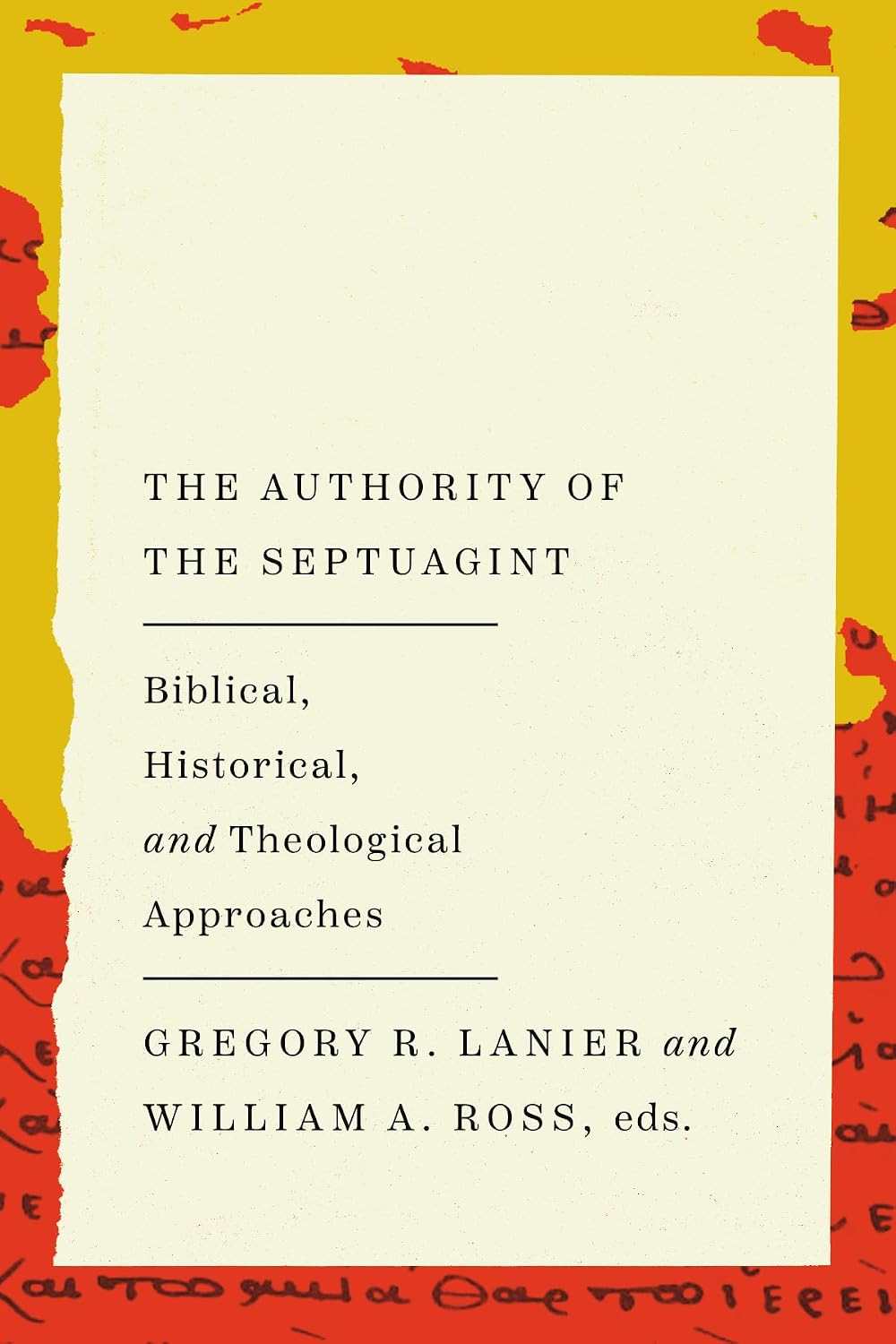
The Authority of the Septuagint: Biblical, Historical, and Theological Approaches
Gregory R. Lanier and William A. Ross, eds.
Purchase at AmazonThe Authority of the Septuagint: Biblical, Historical, and Theological Approaches
Gregory R. Lanier and William A. Ross, eds.
After an introduction, chapters one through four are on the Septuagint in biblical studies. Chapters five and six, including an excursus after chapter six, are on the Septuagint in church history. Chapter seven and the excursus after it is on the Septuagint from a systematic theological perspective. Chapter eight is titled “A Roman Catholic Approach”, and chapter nine is a summary and synthesis of the preceding chapters of the book. An afterword is provided by Karen H. Jobes.
In reading this book, one will quickly realize the variety of views involved with manuscript transmission, the LXX, and Biblical translation. Different figures throughout church history have thought very differently about the place of the LXX in the life of the church. In some periods the LXX was seen as fully authoritative. In other periods the LXX was viewed as basically unneeded. Different traditions have different views as well. Protestants may view the LXX as having some value in trying to find the most original reading of the Bible, while the Eastern Orthodox tradition views the LXX as the standard OT text (for a very helpful graph comparing the views of these different periods and traditions, see p. 232).
Within conservative evangelical Protestantism, we have to acknowledge the complexities that exist in thinking about the Bible. There are difficulties around the transmission of certain OT texts (such as Deuteronomy 32:43). There are questions on how to translate key Old Testament verses (should Isaiah 7:14 be “The young woman will conceive” [MT] or “The virgin will conceive” [LXX]?).
Any honest treatment of these realities will raise questions around the Septuagint. Questions will also arise at Bible studies when participants look at a NT author reference an OT text and see in their Bible’s footnote a comment about the Septuagint. Likewise, pastors and teachers of the Bible will grapple with the LXX as they wrestle through the NT authors’ direct quotations of the LXX, especially in places when the translation seems to diverge from what is seen in the Hebrew OT. We need to humbly address such situations rather than ignore them or brush them off.
A well-known position on inerrancy states that we believe the Bible is “inerrant in the autographs” (ETS Statement of Faith). This means that the original texts, such as the book of Isaiah as it was written by Isaiah, are without error. The reality, however, is that we do not have any of the original manuscripts today. What we do have are faithful transmissions of these originals, and through study and comparison of all the texts available to us, we have confidence that we can trust the Bible we have today.
And with this, let us return to our opening discussion on Hebrews 1:6 and Deuteronomy 32:43—how should we understand what the author of Hebrews is doing here? Well, since Hebrews 1:6 is citing a text found in the LXX, and since this version of Deuteronomy 32:43 is also attested in other places like Qumran (Dead Sea Scrolls), it is very likely that the LXX version of Deuteronomy 32:43 points to an older Hebrew tradition than the MT (see 163–165). In this way, the LXX actually helps us get at the more original reading of Deuteronomy. So in such an example, the LXX helps us with deducing the most reliable reading of the Old Testament.
Moreover, the LXX also helps us see the importance of Bible translation. The NT authors citing from the LXX tells us that Bible translation is a good thing. The LXX was translated to help Greek, non-Hebrew speakers understand the Bible. The NT writers cite it to speak to their audience who understand Greek. Today, we follow this same model and translate the Bible into languages that are familiar to the people who read them.
For these reasons and more, the LXX is worthy of our engagement. Yes, it is a complex document with a complex history, but there are resources and tools to help us. So if you want to learn more about the LXX and its relationship with the Hebrew OT, Greek NT, and the history of the church—and I hope you do—then start by picking up and reading The Authority of the Septuagint. It has given me a far greater appreciation for the place of the LXX in God’s plan of redemption, and I believe it can give you such an appreciation as well.