



Listen to the author read this article
Drowning in Words, Parched for a Word From God
Reflections on Writing in the Age of AI



Nobody knows exactly when, but not long ago, or not long from now, the total written output of AI large language models will surpass the total written output of human beings for all time. And barring a worldwide cataclysm that resets us back to the stone age, there’s no chance human writing will ever catch up.
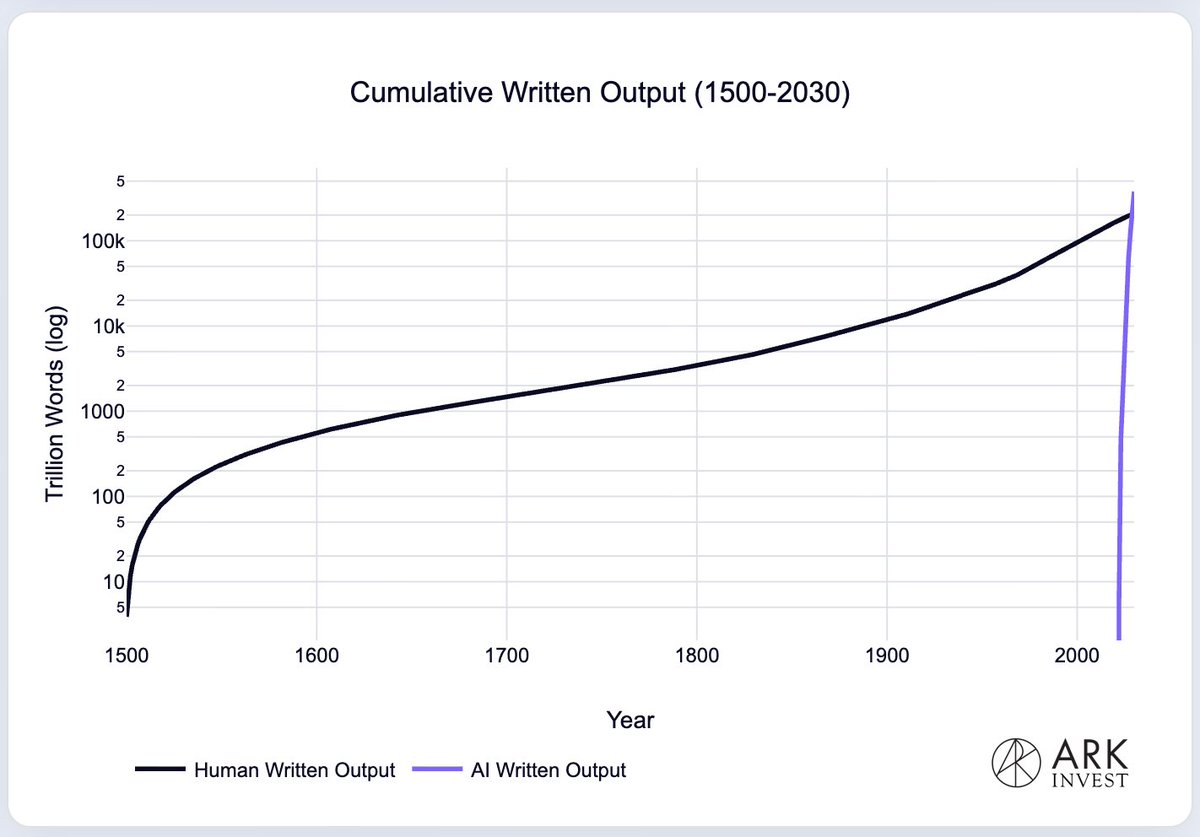
The shape of the graph summarizing this is striking. To be fair, I don’t know how reliable the data this graph is based on is, but I think we all recognize that the general shape is correct.
In my own writing, and in my role as editor of TGC Canada, I’ve been thinking a lot about what it means to write in the age of AI, what distinguishes human writing from machine writing, and why—with blessedly few exceptions—humans will always prefer human words to machine words.
Look around at the pace of change and the new realities being manifest around us, such as the stream of stories of this or that writer or politician being exposed for passing AI material off as their own, or the glut of AI-generated slopbooks being sold on Amazon—many of them specifically designed to fool customers who are looking for a particular (human) book. These new tools present themselves as powerful temptations for those drawn to the prestige of being published, or even less nobly, just the allure of making easy money through swindling.
But underneath these realities is something more fundamental. The word—our most basic unit of language—is not a human invention. Words are so familiar we never stop to behold and consider them. The word is one of those things we use but don’t really see. But perhaps this historical moment, when in the matter of a handful of years our usage of words has been eclipsed by that of our own creation, is the right moment to think a little more deeply about the word, where it comes from, and what makes it special.
Language—A Human and Divine Capacity
Our human capacity for language is unique among the animal species on earth, though of course animals can and do communicate in their own way. They do not, however, converse as we do, and they do not have any written language. This capacity is a gift from God, just as language itself is a gift from him.1 The first spoken word we come across in the Bible is in the third verse: “Let there be light.” This raises an intriguing question: how fundamental is language to the nature of God?
The Scripture says God spoke creation into being, which implies that there is such a thing as language before creation itself. Does this mean there is such a thing as a language without words? Or perhaps what we think of as words are not as arbitrary as we might think. These are glorious mysteries we cannot fully comprehend. Perhaps this idea of creating-through-speaking is an accommodation for our limited understanding. Perhaps human language reflects God’s language in a dim and partial way, like the way a two-dimensional drawing can attempt to represent a three-dimensional shape.2
Regardless, God creates through his Word, resulting in what theologians call natural revelation. The world we see reveals much about the One who made it. But then we have another kind of self-revelation, what we call special revelation: the Scriptures. Or to use another term, the Word of God. 66 books, 1,189 chapters, and approximately 445,000 words in the original languages.
Drowning in Words
Our world is now drowning in words. Doing some napkin math from the chart above, we can say that for every word in the Bible, humanity has produced approximately 225 billion words. Add in the glut of AI-generated words, and more words have been published this week alone than you could read in your entire life, not to mention all the millions of words spoken on videos and podcasts. Words are meant to convey meaning, but the sheer volume of words being poured out continually becomes just noise.
And not just noise, but words become weightless. They float across our screens, we skim through trite listicles and social media posts and listen to podcasts at 2x speed—words, words, words, screaming by in a blur. To find something truly worthwhile in this deluge of language is a new kind of challenge, one that will only become more difficult with time. There is an important role here for trusted thinkers who can recommend good writing to others—what Jake Meador, editor of Mere Orthodoxy, has called “the ministry of curation.”
We long for words that have weight and substance, words which can stop us in our tracks.
The quickly-multiplying number of words out there has not changed the fact that good writing still has considerable power. As John Piper likes to say, “Books don’t change people; paragraphs do, sometimes even sentences.” The right phrase in the right place can shift a person’s entire paradigm, or move their affections in a new way. It can reveal sin, cure a blind spot, or open the eyes of the heart to a glorious truth.
It is the Lord’s good pleasure to primarily use words to accomplish his Kingdom work in our hearts and lives.
Parched for a Word From God
This, ultimately, is what every writer is trying to achieve. We write in imitation of our Author in heaven, whose words create and shape reality itself. Every writer aims for their words to have some desired effect, for their words not to return void (Isa. 55:10-11).
As for readers, it’s worth asking why they clearly prefer human words to machine words. In a large 2025 Ipsos poll of over 20,000 respondents spanning 30 countries, 70% of respondents said they prefer human-written news articles and websites to AI-written ones. Interestingly, Canada and Australia were tied for the second-highest ranking, with 80% of respondents preferring human writing. If I had to guess why people respond this way—and it’s remarkably consistent across many different surveys—it’s because we intuitively know that writing flows out not merely from a brain but from a life.
In one sense, the amount of words does not matter. As the incalculable torrent of AI-generated words pours forth, our greatest need is still a word from God. At least some people sense this. Why else, in the very same years (2019-2025) that have seen the biggest rise in AI-generated words, have sales of Bibles more than doubled?
One of the deep and simple truths about the Scriptures that I gleaned from Kevin Vanhoozer’s Mere Christian Hermeneutics (Zondervan Academic, 2024) is the idea that God’s Word is living and active. It is ever speaking to us. In the book he gets at this by reflecting on Hebrews 3 and 4 and the repeated quotation from Psalm 95 (originally written by David): “Today, if you hear his voice, do not harden your hearts as in the rebellion.” The author of Hebrews says “the Holy Spirit speaks” those words—in the present tense. “Verb tenses always matter, but especially so here,” writes Vanhoozer (9). “If the author of Hebrews could view the Spirit who spoke through David as speaking today, (i.e., to his audience) then we should too” (9).
The takeaway is this: every time God’s Word is read or spoken, God is speaking. That portentous word, today, is born anew every morning. Today, God the Holy Spirit is speaking through his holy Word to reveal Christ the Word. Let us not harden our hearts to these words of life.
Two Convictions
What am I trying to get at? Simply that the Word of God is unique in its nature and power. It is God’s speech, and it continues to accomplish what he wills. As for our own writing, we must be modest. We hope to write well, to harness the power and beauty of language, and to accomplish some good.
At TGC Canada, we still believe in the power of the Word, as well as the (lesser) power of the written human word. Our commitment to our readers is that, as far as it depends on us, all the writing you see on our website is genuinely human writing. In recent days, TGC US has drawn a line in the sand on AI writing in a very similar way, absent any coordination. Mere Orthodoxy and Christianity Today have similar policies. We may quibble about some details (is using AI for brainstorming or fact-checking out of line?), but the core commitment is there: genuinely human writing, even if it’s less efficient and cost-effective.
The floodwaters of AI-generated words may be rising all around us, but these two convictions will continue to guide us: people want and need writing that comes from genuine human hearts, minds, and lives; and most of all, there are no words like God’s words.
1 However, we ought not say that the use of language is part of what it means to be made in God’s image. This notion, though well-intentioned, implies that the non-verbal among us are less than fully human, or are not made in the image of God in the same way as others. Rather, we need a robust biblical anthropology that affirms the goodness and dignity of every human person, regardless of outward health, capacity, or ability. We are in the process of commissioning and publishing some articles in the coming months that deal directly with this question, so stay tuned for that.
2 I think of C.S. Lewis’s essay, “Transposition”, from The Weight of Glory, where he says:
If you are to translate from a language which has a large vocabulary into a language that has a small vocabulary, then you must be allowed to use several words in more than one sense. If you are to write a language with twenty-two vowel sounds in an alphabet with only five vowel characters then you must be allowed to give each of those five characters more than one value. If you are making a piano version of a piece originally scored for an orchestra, then the same piano notes which represent flutes in one passage must also represent violins in another.
As the examples show we are all quite familiar with this kind of transposition or adaptation from a richer to a poorer medium. The most familiar example of all is the art of drawing. The problem here is to represent a three-dimensional world on a flat sheet of paper. The solution is perspective, and perspective means that we must give more than one value to a two-dimensional shape. Thus in a drawing of a cube we use an acute angle to represent what is a right angle in the real world. But elsewhere an acute angle on the paper may represent what was already an acute angle in the real world: for example, the point of a spear on the gable of a house. The very same shape which you must draw to give the illusion of a straight road receding from the spectator is also the shape you draw for a dunces’ cap. As with the lines, so with the shading. Your brightest light in the picture is, in literal fact, only plain white paper: and this must do for the sun, or a lake in evening light, or snow, or human flesh.