




British poet, Anglican priest, and academic Malcolm Guite seems like a man from another era. In his widely watched YouTube video series “Spells in the Library”, he appears with a white Gandalf-like beard, wearing Hobbit-like tweed, and sitting comfortably in an old, well-worn reading chair amid crammed bookshelves, empty tea mugs, and dishevelled papers.
With a Peterson pipe clenched between his teeth and a pint of ale in hand, he warmly welcomes viewers into his study with magnanimous hospitality, and encourages his audience to delight in the wisdom of great poets and storytellers. As you listen to him, or better yet, read his work, you quickly sense you are in the company of a long-lost member of the Inklings, that famous mid-twentieth-century Oxford literary circle of C.S. Lewis, J.R.R. Tolkien, and Charles Williams.
Like them, Guite seeks to restore great storytelling and the Christian traditions of truth, beauty, and goodness to contemporary readers. He is, however, neither an anachronism nor a museum curator of nostalgic tales. His poetry echoes the past without replicating it; it is new art built on ancient footings.
Nowhere is this more apparent than in the recent release of Galahad and the Grail (Rabbit Room Press, 2026), the first instalment of Guite’s four-part Arthurian epic. The long narrative poem picks up the legend of King Arthur’s knights as they set out on their quest for the Holy Grail. The story is full of adventure, acts of bravery, temporary defeats, and the ultimate triumph over foes and personal flaws.
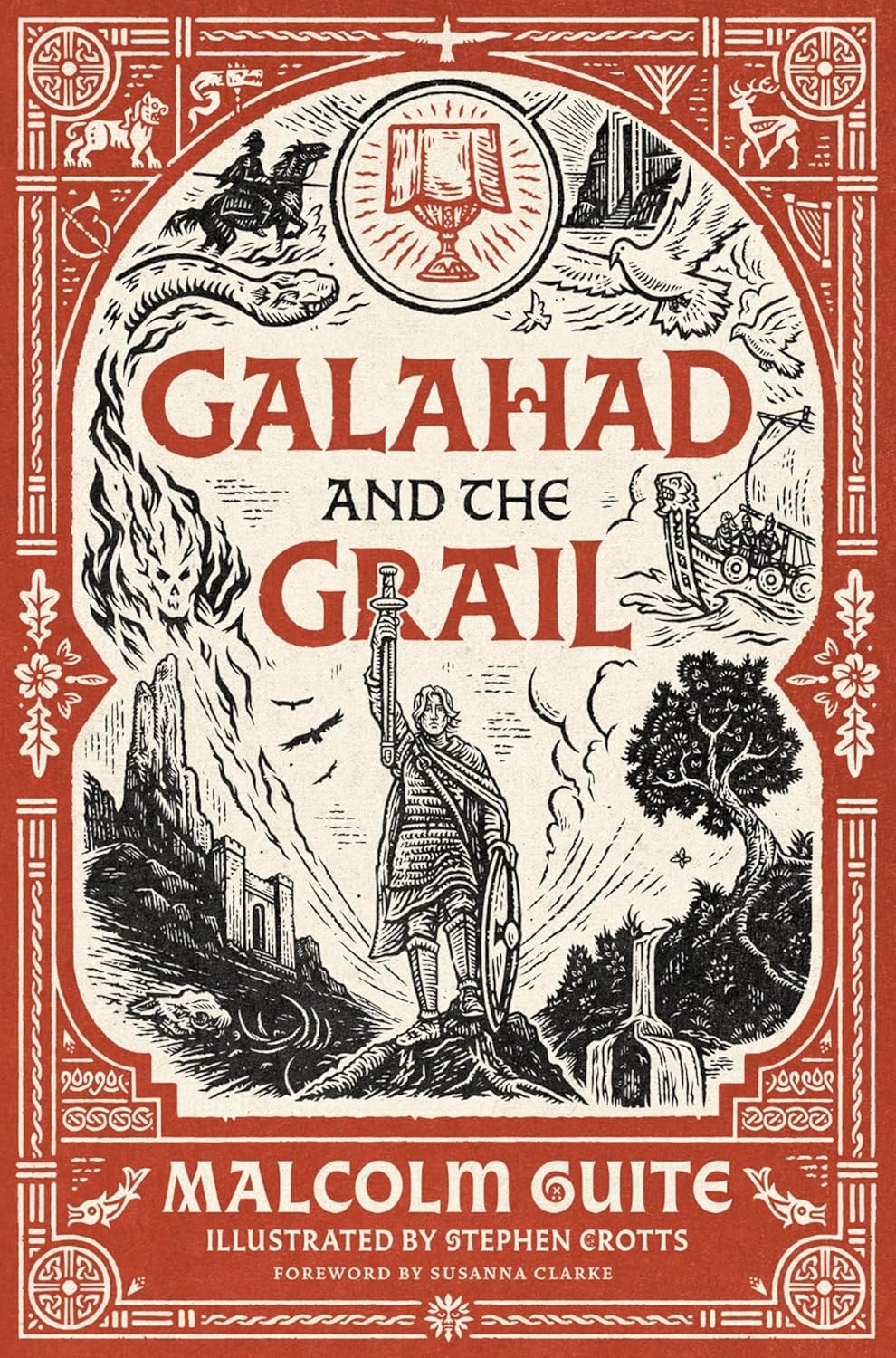
Galahad and the Grail
Malcolm Guite (Author), Stephen Crotts (Illustrator), Susanna Clarke (Foreword)
Purchase on Amazon.comPurchase on Amazon.caGalahad and the Grail
Malcolm Guite (Author), Stephen Crotts (Illustrator), Susanna Clarke (Foreword)
Some evangelical Christians may instinctively hesitate before picking up a book about Camelot, the Holy Grail, and Arthur’s “knights errant”. What value, one may wonder, does an epic poem about medieval legends and superstitious relics have to do with our twenty-first-century world? The book’s rapid rise to bestseller status, however, suggests it resonates far beyond its obvious audience of fans of legends, fantasy stories, and historical fiction. Like Tolkien’s Gandalf, who remarked that “a wizard is never late,” Guite’s poem arrived precisely when we needed it most. Yet it is far more than an entertaining diversion for readers weary of endless news cycles about war, economic setbacks, and social upheaval.
Galahad and Grail restores our wonder at God’s supernatural activity in the world, reclaims a Christian cultural inheritance being quietly erased, and reawakens our appetite for ancient poetic forms and epic fairy stories, genres through which great truths are often best told. Guite’s Arthuriad, when rightly understood, stands as a powerful tool for cultivating the Christian heart, mind, and imagination, and it is worth reading for four main reasons.
Baptizing of Our Imaginations
Guite presents Arthur’s noble knights engaged in a pious quest for the Holy Grail, the cup believed to be used by Jesus at the Last Supper and, in medieval legend, by Joseph of Arimathea to receive Christ’s blood at the crucifixion. Modern Christians might assume such legends belong only in Indiana Jones films or Monty Python parodies. But Guite is not asking us to renew belief in legendary heroes or mystical relics. He is challenging the cold, materialist mindset that has subtly shaped much of Western Christianity.
As Christians, we profess belief in the supernatural, yet in practice we often live as functional materialists, disenchanted with the mystery and wonder of God’s workings in creation. This is why Guite’s poem is so important. He is taking up the task of the Inklings—and of Lewis and Tolkien in particular—who not only sought to “repair the ruins” of forgotten Christian literary traditions but also “re-redeem” the spiritual imagination of contemporary readers. A major theme in much of Guite’s writing is the “recovery of the imagination as a truth-bearing faculty.”1 So, Guite means to “‘slip past the watchful dragons’ of secularism and awaken again in the modern world that openness to beauty and mystery which prepares the heart for the coming of Christ.”2
This re-enchanting mission is what C.S. Lewis called “praeparatio evangelica”, that is, preparation for the good news.3 The goal of such literary works is to prepare our hearts and minds, and—as Guite frequently argues is also vitally important—our imaginations to welcome gospel wonder back into our lives. Galahad and the Grail is a powerful tool in achieving this.
In his memoir, Surprised by Joy, C.S. Lewis explains how God “baptised” his pre-conversion imagination through the fantasy novels of the 19th-century writer George MacDonald. Upon reading MacDonald’s Phantastes, “a fairie Romance,” Lewis wrote that his imagination was “in a certain sense, baptised; the rest of me […] took longer.”4 It would be 15 years before he came to faith in Jesus Christ, but his imagination had been awakened to Christian truth, especially to holiness, faith, and joy as real rather than mere products of chemical reactions in the body or wishful thinking in the mind. This awakening of our Christian imagination is precisely what Guite’s poem is designed to accomplish in readers today.
Whether or not a historical knight named Galahad ventured out on a quest for the Grail, the historical fact remains that Christ used a real cup at the Last Supper, was nailed to a real cross with real iron nails, was pierced by a real Roman spear, and was buried in a real tomb. Amid these historical realities, the sky miraculously grew dark, the curtain in the temple miraculously tore, the earth miraculously shuddered, tombs miraculously burst open, and Jesus miraculously rose up from the dead. God is a God of history and of miracles, and he continues to act in divine and supernatural ways in the world. What Galahad and the Grail does for Christians is rekindle our enchantment for God’s marvellous dealings in creation.
The world, Guite insists, has always been enchanting; we have simply forgotten. When we read Guite’s poem, we are reminded that “we do not wrestle against flesh and blood, but against the rulers, against the authorities, against the cosmic powers over this present darkness, against the spiritual forces of evil in the heavenly places” (Eph. 6:12). Guite’s poem baptises the imagination of its readers, imbuing their creative faculties with Christian truth and reorienting them to live “coram Deo,” before the face of God, in whom “we live and move and have our being” (Acts 17:28).
Reclaiming the Christian Legends
Some historians and theologians have observed that the Western world, though once formed out of Christian truth and a biblical ethos, is rapidly becoming a post-Christian culture.5 The Church will assuredly prevail (Matt. 16:18), but this cultural inheritance—with values such as love, equality, sacrifice, service, justice, forgiveness, mercy, and grace—is being forgotten, and in some quarters, monstrously distorted. As C.S. Lewis warned in The Abolition of Man, modern education systems are producing what Lewis called “men without chests.” For Lewis, these are people who lack the capacity for virtue and honour, and are ruled instead by self-serving and undisciplined emotions. “We make men without chests,” Lewis writes, “and expect of them virtue and enterprise. We laugh at honour and are shocked to find traitors in our midst.”6 This is, in large part, why Guite set out to write his epic. As he has stated, he wanted to write a “Christian poem in a time when both Christianity and poetry were being pushed to the edges. I wanted to put them back in the center of things.” His poem portrays men with chests—knights who embody and live by virtue and honour. Though they are not without failures or flaws, they receive the same grace, mercy, and strength from God that all who believe in Jesus can receive.
Guite is not being preachy or didactic in his poem; rather, like a gospel parable, he presents a beautiful portrait of the Christian life through the story of Arthur’s knights. “My aim,” Guite writes, “is to make a poem that restores the spiritual elements that have been shorn away and renews their deepest meaning.”7 In many ways, Guite’s poem is a conscious reaction to the intentional de-Christianizing of these legends. It has long been fashionable to celebrate the pagan roots of Celtic, Norse, and Anglo-Saxon mythology while marginalizing or erasing the “deep Christian impulse” that shaped their most enduring retellings. As Guite notes in his rich appendices of Galahad and the Grail, upon encountering the Arthurian source material as an undergraduate at Cambridge University, he discovered that many modern versions had done precisely this.
Guite argues that the legends, in their original iterations, are “haunting, numinous, continuously suggestive of the holy and beautiful reality of God.”8 This is what Jerram Barrs calls “echoes of Eden,” since even pagan myths ultimately find their origin in God the Creator. 9 As Tolkien and Lewis have argued, Christianity liberates these myths by pointing us not only back to Eden and our need for Redemption, but ahead to our Redeemer and the “true myth” of Christ’s redeeming work on the cross.10 Ralph C. Wood explains in his book, The Gospel According to Tolkien, that Lewis and Tolkien regarded “many of the world’s myths and fairy-stories as forerunners of and preparations for the Gospel—as attempts of fallible humans to tell the Story that only the triune God can tell perfectly.”11
Many myths, legends, and fairy-stories—especially those with happy endings—offer what Tolkien argued as “a far-off gleam or echo of Evangelium”—that is, the good news of the gospel.12 This is precisely what Guite achieves with his Christian re-telling of the quest for the Holy Grail. The story ends (spoiler alert) on a satisfyingly happy ending, with not only an echo of Eden and a foreshadowing of Christ, but with Christ himself, the ultimate desire of all nations (Hag. 2:7).
Feasting on the Hearty Form of Epic Poetry
Galahad and the Grail is written in the song-like, rhyming style of an English ballad, a form Guite advises readers to experience aloud, ideally in the company of friends. In “taking up the tale,” he is tapping into a timeless tradition of minstrels, bards, and storytellers who not only retold great stories, but reinvented them for new audiences. Without a doubt, Guite’s poem belongs in the rich lineage that runs from Homer and Virgil through Dante and Milton, from Beowulf and Chaucer’s Canterbury Tales through Edmund Spenser’s The Faerie Queene and, closer to our own time, G.K. Chesterton’s The Ballad of the White Horse and T.S. Eliot’s The Wasteland.
His occasional use of archaic vocabulary adds linguistic richness, and reminds us that language need not be merely utilitarian but artful for its own sake, appearing on the page like brushstrokes on a canvas and sounding like notes in a symphony. Guite’s choice of words also elevates the text and helps the reader experience the epic quality of the work. If this were badly done, it would read as a pastiche at best or a parody at worst. But Guite is a mature and seasoned artist. Nothing is imbalanced, nothing is overdone, nothing is forced. Equally, he avoids the opposite failure of contemporary writing: the tendency toward excessive subtlety, ambiguity, and nuance that renders modern poetry opaque and ultimately meaningless.
In a day and age when artificial intelligence claims to write poetry on demand, Guite offers a profound reminder that we are made Imago Dei, in the image of the Creator God, who is the Supreme Artist, the Great Poet, and Ultimate Storyteller. A genuinely human voice can be heard and fingerprints clearly seen in every line of this poem.
Reading Galahad and the Grail is also likely to send readers “upstream” toward Guite’s sources: the Welsh Mabinogion, Malory’s Le Morte d’Arthur, the Middle English Sir Gawain and the Green Knight, Tennyson’s Idylls of the King, as well as the Arthurian writings of Tolkien, Lewis, and Charles Williams. That is the mark of a great work: it opens doors to other great works.
A Fairy Story for Grown-ups
A fourth reason to take up and read Galahad and the Grail is to be powerfully reminded that such tales aren’t just for kids. Tolkien argued in his seminal essay, “On Fairy-Stories”, that “if fairy-story as a kind is worth reading at all it is worthy to be written for and read by adults.”13 Galahad and the Grail is, in the best sense, a fairy story for adults, a genre the Inklings championed and that our age desperately needs. There is a place for children’s retellings, such as Howard Pyle’s classic The Story of King Arthur and His Knights (1903) or Roger Lancelyn Green’s delightful version King Arthur and his Knights of the Round Table (1953).14 But Guite gives us the legend with its full moral weight, complexity, and spiritual depth. Although children will enjoy it, adults will be transformed by it.
A Final Caveat & Conclusion
Protestant readers may occasionally pause on the Anglo-Catholic texture of the poem’s Eucharistic imagery. From time to time, the medieval knights observe the Blessed Sacrament and the epic quest itself centres on the “cup of Christ” as the chief object of Holy Communion. Nevertheless, Guite navigates both pagan and sacramental elements with rare skill and theological sensitivity, making the work accessible to readers of every Christian tradition. In fact, Guite’s treatment of Mass may help counter our predilection for materialist thinking by rekindling Protestants’ appreciation for the Lord’s Supper.
Whether you are a memorialist or a sacramentalist, Guite’s poem will nurture greater reverence for communion, especially during the scene where Galahad achieves his quest for the Grail. With remarkable theological power, we are witnesses to the Holy Spirit moving and the knights partaking in a joyful celebration of Christ’s cross and empty tomb. We are also faced with a clear proclamation of the gospel as Guite’s poem ends, as Dante’s Paradiso ends, not in triumph of arms, but in the presence of Christ and the love of God prevailing.
Amid the final stanzas of the poem, King Arthur, addressing his court (and Guite, addressing us), commands,
Give ear to good Sir Bors.
For now he taketh up the tale
Concerning all the Holy Grail
And the last lifting of the veil
And how the great quest did not fail,
Which was our holy cause.
And let the scribes take out their pens
And make a record clear,
that all he tells we may recall,
and children’s children be enthralled
by all that’s spoken here.
[…]
The tale of all our hopes and fears,
The tale that passes down the years,
The quest of joy, the quest of tears—
Quest of the Holy Grail.15
And so, in the 21st century, the tale passes down to us, “the quest of joy, the quest of tears.” In Galahad and the Grail, Malcolm Guite has taken up that tale “for such a time as this” (Esth. 4:14), and handed it to us with extraordinary craft and Christian conviction. Read it aloud, by firelight if you can, and let your imaginations be baptised anew.
Galahad and the Grail is the first of four projected volumes in Guite’s Arthuriad. Subsequent volumes will include The Coming of Arthur, The Days of the Round Table, and The Passing of Arthur.
[1] Malcolm Guite, Galahad and the Grail (London: Canterbury Press, 2026), 347.
[2] Guite, Galahad, 316.
[3] C.S. Lewis, The Letters of C. S. Lewis, ed. W. H. Lewis (London: Fount, 1988), 359.
[4] C.S. Lewis, Surprised by Joy: The Shape of My Early Life (Oxford: Geoffrey Bles, 1955), 146.
[5] See, for example, Tom Holland, Dominion: How the Christian Revolution Remade the World (Basic Books, 2019), Sharon James, How Christianity Transformed the World (Christian Focus, 2021), or Glen Scrivener, The Air We Breathe: How We All Came to Believe in Freedom, Kindness, Progress, and Equality (The Good Book Company, 2022).
[6] C.S. Lewis, The Abolition of Man (New York: Touchstone, 1996), 37.
[7] Guite, Galahad, 318.
[8] Guite, Galahad, 315.
[9] Jerram Barrs, Echoes of Eden (Wheaton: Crossway, 2013).
[10] The idea of the gospel being “True Myth” came from a late-night conversation between Tolkien, C.S. Lewis, and Hugo Dyson, a conversation which ultimately led to Lewis becoming a Christian. See C.S. Lewis, “Letter 172, October 18, 1931,” They Stand Together: The Letters of C.S. Lewis to Arthur Greeves (1914–1963), ed. Walter Hooper (Macmillan, 1979), 427.
For further discussions about Lewis’s and Tolkien’s thoughts on the Gospel and “true myth,” see Tolkien’s essay “On Fairy-Stories” collected in The Monsters and the Critics and Other Essays, ed. Christopher Tolkien (London: Harper Collins, 2006). See also C.S. Lewis’s essay “Myth Became Fact” in In God in the Dock: Essays on Theology and Ethics, ed. Walter Hooper (London: Harper Collins, 1998).
[11] Ralph C. Wood, The Gospel According to Tolkien (Louisville: Westminster John Knox Press, 2003), 8.
[12] Tolkien, “On Fairy-Stories,” Monsters, 155.
[13] J.R.R. Tolkien, “On Fairy-Stories,” in The Monsters and the Critics and Other Essays, ed. Christopher Tolkien (London: Harper Collins, 2006), 137.
[14] Roger Lancelyn Green (1918 – 1987) was a friend, biographer, and former student of C.S. Lewis. He was also a member of the Inklings. It was Green who suggested to Lewis that he call his Narnia stories “The Chronicles of Narnia.”
[15] Guite, Galahad, 313.