






I think I have wrestled with the question of usefulness more than anything else since I became a pastor. Shortly after my church called me to ministry, a friend asked me two seemingly simple questions: How is ministry going? Did you have a productive week?
I stammered through an answer as though he asked me to explain quantum theory.
Each week in ministry brings different joys, challenges, and the bewildering realization that what God is doing is often beyond my comprehension. Among several questions regularly percolating in my mind, three tend to rise to the surface:
- Am I useful when my sermon will be forgotten by most people?
- Was I useful in a week filled with phone calls about problems I couldn’t solve?
- Could I be more useful in a different church?
Perhaps I overthink things and need to get out of my head, but the desire to be useful for Christ in our generation is biblical—”Therefore, if anyone cleanses himself from what is dishonorable, he will be a vessel for honorable use, set apart as holy, useful to the master of the house, ready for every good work” (2 Tim. 2:21, italics added).
Pastors are called to be useful.
A Model of Usefulness
This is one reason I’m happy to recommend the recent book, Long May Thy Servant Feed Thy Sheep: The Pastoral Theology of Benjamin Beddome (Pickwick Publications, 2025) by Yuta Seki, Senior Pastor of Maple Avenue Baptist Church in Georgetown, Ontario. The book focuses on the ministry and pastoral theology of Benjamin Beddome, an eighteenth-century Baptist pastor.
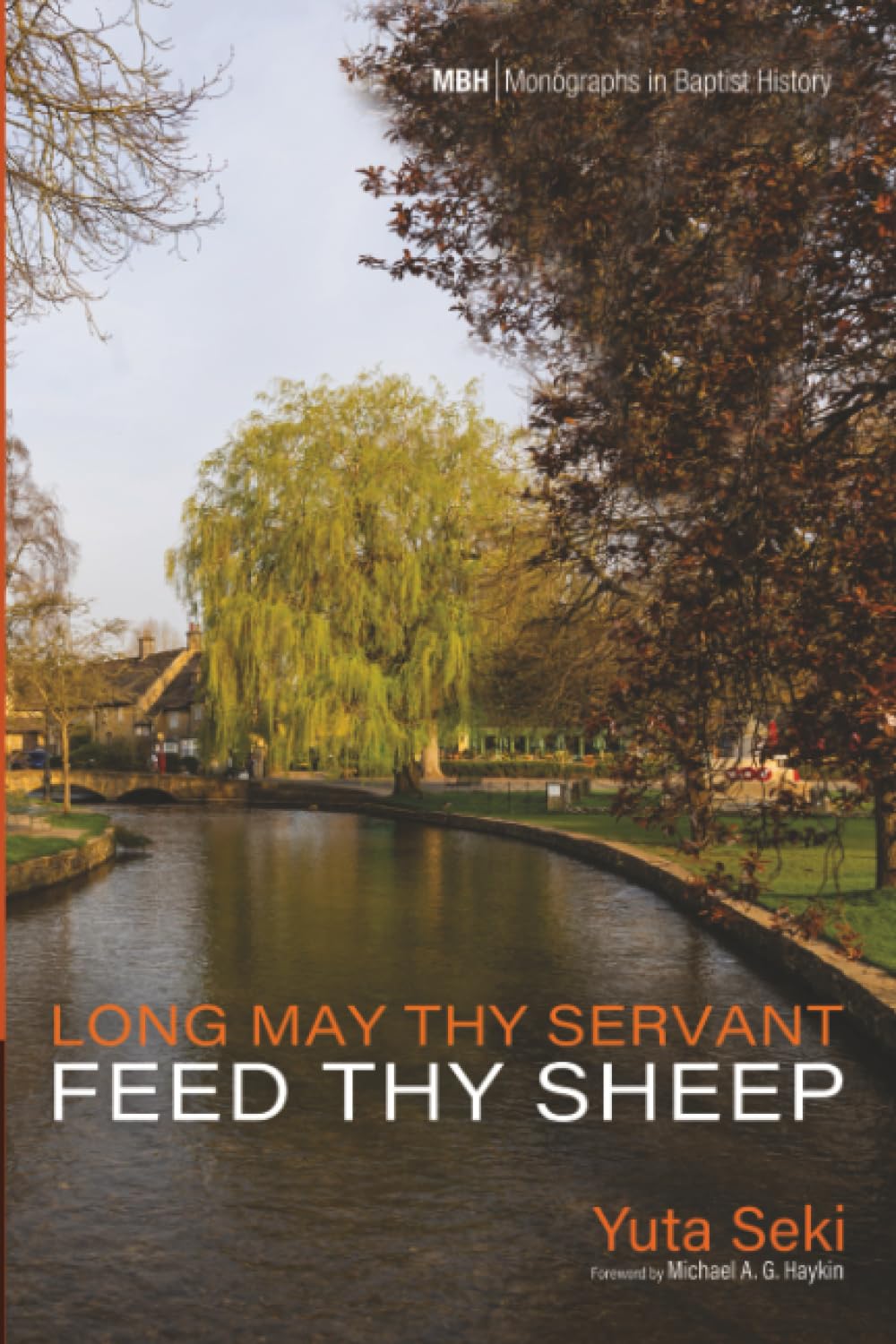
Long May Thy Servant Feed Thy Sheep: The Pastoral Theology of Benjamin Beddome
Yuta Seki
Long May Thy Servant Feed Thy Sheep: The Pastoral Theology of Benjamin Beddome
Yuta Seki
Beddome (1718–1795) pastored for 55 years at the Baptist church in the village of Bourton-on-the-Water. Seki first situates Beddome in the context of eighteenth-century Particular (Calvinistic) Baptist life. An overview of standard ordination services and surveying a sample of ordination sermons helps readers understand how pastors were called to ministry and what the primary emphasis of pastoral ministry was for Beddome’s contemporaries.
From this context, Seki unpacks Beddome’s pastoral theology in two steps. First, from a series of letters in which the Goodman’s Fields church in London requested Beddome to become their pastor, and the responses made by Beddome and the Bourton-on-the-Water church. Second, from ordination sermons Beddome preached, in which he outlines the joys, challenges, and priorities of gospel ministry.
Several points Seki highlights are worthy of reflection, such as the primacy of preaching in pastoral ministry or the way Beddome submitted to the decision of the Bourton congregation regarding him remaining at their congregation rather than moving to London.
But the point that remains with me is the subject of usefulness and two primary applications.
Serve Where You Are Called
As Seki notes, the letters exchanged between these churches and Beddome reveal two contrasting views of usefulness in pastoral ministry. The London church desired Beddome in part because he was a learned minister who had proven himself to be faithful and fruitful in ministry. They considered it would be the most useful way to serve God in their generation. From their perspective, having a man like him in London would best serve the cause of Christ. The conviction governing their desire was: The prosperity of churches in general is to be preferred to that of one (see 76– 77, 173).
The combination of Beddome’s remarkable gifts and the significant influence of the London church appeared to serve the larger body of Christ best. This was clearly the perspective of the London congregation.
A remarkably gifted and “learned” minister such as Beddome remaining in the obscurity of a country church was seen as a missed opportunity. Seki writes, “Given London’s prominence in both the nation and the empire during the mid-eighteenth century, it is not surprising that the Little Prescott Street Church argued this way” (173).
Beddome and the Bourton congregation had a different concept of usefulness. Giftedness was subordinate to faithfulness, and giftedness was no promise of fruitfulness (see 80–86). A key point in this concept of usefulness for Beddome was that pastors were Christ’s gift to churches. Ephesians 4:11, as Beddome and others in the Particular Baptist tradition understood, taught that pastors are Christ’s gift to the church, “dispensed by the sovereign Lord to his church to advance ‘his glorious cause’ in this world” (117). Since pastors are Christ’s gifts to churches, usefulness is not determined by a pastor’s gifts but by faithfulness to God’s call. In his final reply, Beddome told the London church why he was unwilling to leave his congregation without their approval: “I am determined that I will not violently rend myself from them, for I would rather honour God in a much lower station than … intrude myself into a higher without his direction” (175–176).
In their final letter to the London church, the Bourton church asserted, “Usefulness consists not barely in preaching to a very great audience, but in honouring religion by serving God and our generation in that post in which he sets us” (89). Seki summarizes the view of Beddome and the Bourton church, “if God appointed a pastor to a place, he should not presume that his usefulness would continue in another place unabated” (175). Usefulness isn’t about our gifts, but God’s work.
Pastors and Pride
Pastors must remember the subtle but significant difference between a pulpit and a platform. A pulpit is where you stand behind God’s word to proclaim his message to your generation. A larger sanctuary, a more public ministry, a podcast, and biographies written about you is not God’s call for every pastor. Sometimes pride within her ministers harms the church the most.
How do we conceive of usefulness? What metrics do we use to determine a pastor’s usefulness? Are we governed by the logic that the most gifted pastors must pursue the biggest churches? Would a young and gifted pastor be content to minister for 50 years in Timmins, Ontario? Or would he be pressured to find a gospel ministry in downtown Toronto, Vancouver, Montreal, or other major Canadian city centers?
Rather than asking “where can I have the greatest influence?” Ask, “where has the Lord called me?”
Promote the Joy of Your Church
Beddome saw pastors as helpers of their people’s joy in God (125). The great aim of preaching—which is the primary duty of pastors, according to Beddome—“is to hold forth Christ, to recommend him to our attention in all his endearing characters and offices … who by his blood has made full atonement for sin, who by his grace can soften the hardest heart, and subdue the most inveterate enmity” (172).
A pastor doesn’t hold forth Christ simply because he must, but from a depth of affection for those to whom he preaches. Pastoral ministry is a labour of love. Pastors who don’t love the congregations God stations them in may be great communicators, but are as useful as a noisy gong (1 Cor. 13:1).
Such love, which is not unimportant in a “useful” ministry, is returned by the church toward her pastor.
A regular element in the ordination services for eighteenth-century Particular Baptists was an address to the church regarding their responsibilities toward their new pastor and toward one another (44–45). Every duty given to pastors comes with a corresponding responsibility upon the church to which Christ appoints them. If pastors are called to preach, church members must attend to preaching with care. If pastors are called to govern, church members must receive pastoral oversight with humility and joy. If pastors are called to love the church with the sacrificial love of Christ, church members have a duty to respond in kind and care for their pastor and his family.
As Beddome conceived, pastors are Christ’s under-shepherds whom he gives to churches as gifts won by his redeeming work and an expression of his love.
Emphasizing this point, as Seki explains, can be difficult for pastors. “For a pastor to call his church to their responsibility to show affection toward, have esteem for, and contribute financially for the sake of their minister can undoubtedly be difficult in its own way” (181). However, this difficulty shouldn’t lead to neglect. Churches need to be equipped to love their pastors, and a part of pastoring is equipping the saints for this service (Eph. 4:12).
Beddome and the Bourton congregation are a beautiful model of this duty of love reciprocated between a pastor and congregation. One writer described Beddome’s ministry this way: “He lived in the affection and esteem of his own people. They were near his heart; he dwelt in their hearts” (103).
Such a summary should be the aspiration of all pastors. Usefulness is not always measured by the number of eyeballs on your ministry. A depth of love might indicate a greater usefulness.
A Useful Model
Seki’s book is a gift to the church. Beddome was an ordinary pastor of a village church. More than just someone we might admire, he is an exceptionally useful role model for the average pastor and the average church today.