


“Where is Jesus in the Old Testament?” “Why is God so mean in this verse?” “What is Joel even saying?”
As both the children’s ministry coordinator and a youth leader at my church, I have a unique opportunity to see what questions are on the minds of younger generations. The above are some such questions from our local teens.
Upon further conversation, it’s usually revealed that they were never introduced to the Old Testament, or only to specific children’s stories, and now as young people grappling with new faith, they have the intimidating task of journeying through the messy history of Israel. I’ve come to take on a certain passion for the Old Testament in the hope I can help them, especially as they move from the more straightforward historical narratives and into the murky waters of prophecy.
Often their questions revolve around the character of God and the apparent contrast between the God of the Old Testament and Jesus. When children are taught the New Testament separately from the Old, and when God’s wrath is ignored for the comfort of his love, they later discover these issues on their own and must wrestle with the incomplete biblical picture they have always known.
Stumbling Upon the Series
Realizing these questions could be addressed before the teenage years, I began to consider how we could round out our Sunday school curriculum. It was then that I stumbled on God’s Daring Dozen, an illustrated series by Brian J. Wright and John R. Brown.
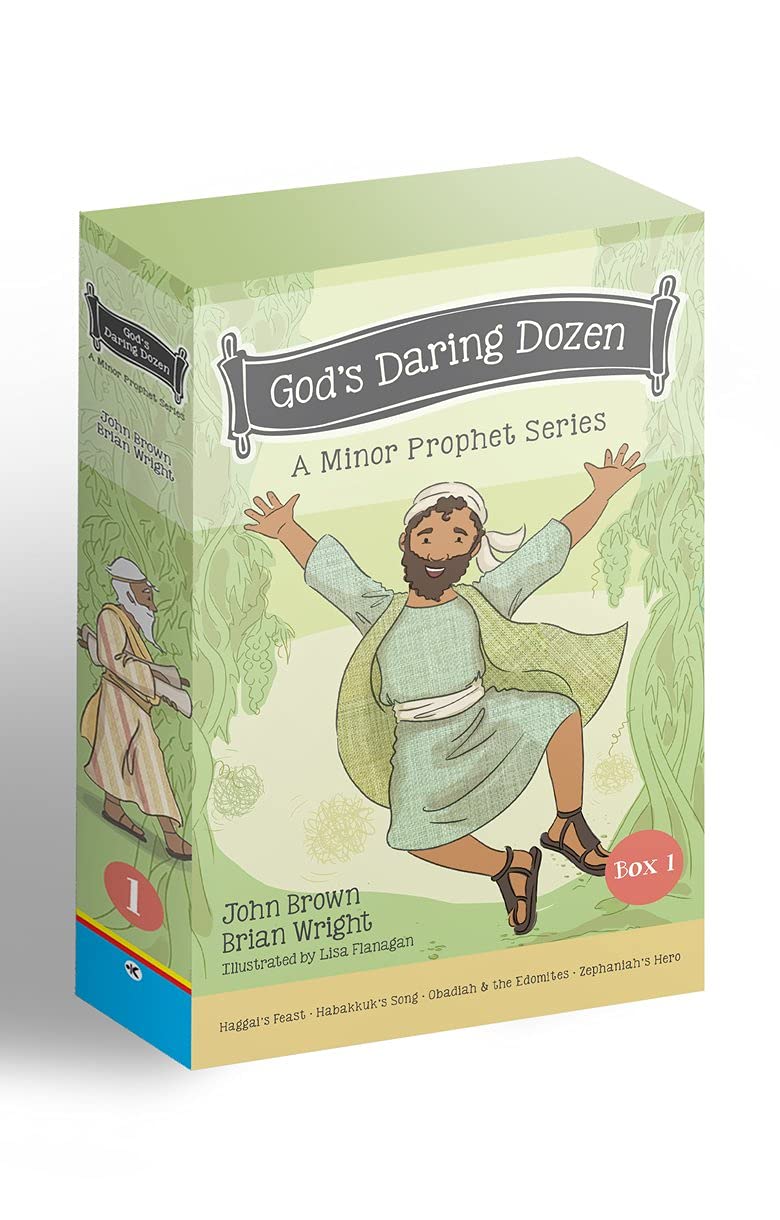
God's Daring Dozen, Set 1
Brian J. Wright and John R. Brown
I’d found a donated copy of Jonah’s Journeys from the series. I was impressed by the clear imagery and the simplified text of Scripture. Near the end, I was delighted to find the fourth chapter of Jonah as more than a footnote (the plant is not nearly as exciting as the fish), and that the final pages not only reinforced the moral lessons of Jonah but referenced Matthew 12 and connected Jonah to Jesus.
I convinced our church administrator to buy a few more to vet the series. We chose Hosea (Hosea and God’s Love) and Nahum (Nahum and the Ninevites)—how would this series deal with adultery and destruction?
Very well, it turned out. Vulgarity and gore are not needed to impart the wisdom of God’s words. Gomer’s actions are described as having “a wandering heart”, and the illustrations show her waving to other men. The text clearly draws the parallel of Hosea’s and God’s faithfulness against Gomer and Israel’s disobedience.
In Nahum, the language retains the poetic imagery of God’s judgement on Nineveh. The illustrations, which in my experience leave a lasting impression more than the text as pre-reading children stare at the images, are vivid and reflect the poetry. Vines tangle the soldiers, floods topple the city wall, spears glint from a dust cloud, the city burns in the distance while shepherds sleep.
The strength of both books is the final pages. Hosea connects the Davidic king to Jesus, ending with the reminder that we are never beyond the reach of Jesus’s rescuing love and to commit ourselves to him. Nahum reminds us that, while not a comfort to his enemies, God’s Word is a comfort to his people, and he will not let sin go unpunished.
Pointing to Jesus
Satisfied with the content, we ordered the rest of the series. While the main strength of the series is its emphasis on connecting to Jesus, it is an impressive set in many ways. Lisa Flanagan’s colourful illustrations catch the eye and reinforce the text or add clarity. Effort was made to show era-accurate artwork, fashion, and industry; the Babylonian gates look different from the architecture of Israel.
The text tries to keep narrative and poetry and song distinct, making each telling unique but in line with its source text. I could open my Bible next to each book and track line by line the Scripture that was used.
While all the books conclude with Jesus, some do this more directly than others. Jonah and Zechariah place more emphasis on how exactly Jesus appears in their stories. Nahum and Habakkuk focus more on God’s sovereignty shown through the story, with a brief tie-in to Jesus at the end. They also bring in other references to prophecy or history. Joel references Acts 2 and the pouring out of the Holy Spirit at Pentecost through its illustrations.
Obadiah and Malachi give context from Genesis to show how the tensions between Jacob and Esau carried over into the nations. These connections help make each prophet feel grounded in the overarching story of redemption.
The one flaw of the series, if one could even call it that, is that the distillation of Scripture into bite-sized phrases occasionally feels disjointed. However, reading aloud helps keep the meter of the phrases, and the illustrations brilliantly reinforce the thought of the page, so comprehension is not lost.
Brown and Wright have handled the task of reducing massive chunks of text into language readable for young minds without losing much of the notable images or themes common to the prophets. Zechariah especially retained a clear voice throughout, despite sometimes having a lot of words on a page. It was one of the standout books for me, as were Haggai and Amos.
This series is meant to be read to children aged 4–6 and read independently by ages above. I recommend introducing these books as a family or with parental oversight and then encouraging independent enjoyment. While the weighty themes are handled with care, they may still be heavy to young ears and minds, and this should encourage discussion.
Our church has been helping parents start family devotional practices, and we are introducing these books with inserts of context, themes to notice, and prompts for discussion.
Don’t Shelter Them From the Prophets
2 Timothy 3:16 says, “All Scripture is breathed out by God and profitable for teaching,” yet the Minor Prophets often go neglected even by seasoned Christians. They are intimidating, requiring a bit more understanding of the Old Testament to really get the nuance and imagery, and they present a side of God that can make us uncomfortable.
That is precisely the reason we cannot hide these books from our children. The children of the Old Testament lived through these events. They were not sheltered from the details of the Exodus or exile. These histories were recited often, to keep them fresh in their memory, as shown in Psalm 78 or commanded in Deuteronomy 6:7.
They intimately understood that God’s love and wrath are not inconsistencies of his character, but two expressions of the same love, poured out in restoration for his people and in judgement for sin. Our children must not be robbed of the same understanding. If we teach them God is love, and they see his wrath toward sin, they should also be taught that the safest place from God’s wrath is within his arms.
Brown and Wright have created an excellent resource, one that proves edifying for all members of the family. These books will encourage the next generation of believers not to be intimidated by any part of the Bible and to understand both God’s love and justice. This series is as educational to the parents as to the children, teaching everyone to see the gospel in all books of Scripture.