




“Puritanism—The haunting fear that someone, somewhere, may be happy.” — H.L. Mencken
For many, H.L. Mencken’s characterization of puritanism could well be applied to the “Reformed” label. Indeed, in many Christian social circles, to identify as Reformed is to mark oneself out as a particularly severe kind of Christian. It probably means you don’t laugh very much. And there’s a chance you dress your toddlers in t-shirts that say “Totally Depraved.” Or at least you’re open to it. As part of a small group of “elect” Christians, you believe everyone else is damned—because God made them that way; and what’s that to you, anyway?
Such impressions miss the mark, however, and the co-authors of Generously Reformed: Theology Rooted Deep and Reaching Wide (Baker Academic, 2026) explain why, how, and in what ways the above caricature is in fact a departure from, rather than a genuine expression of, what it has historically meant to be Reformed.
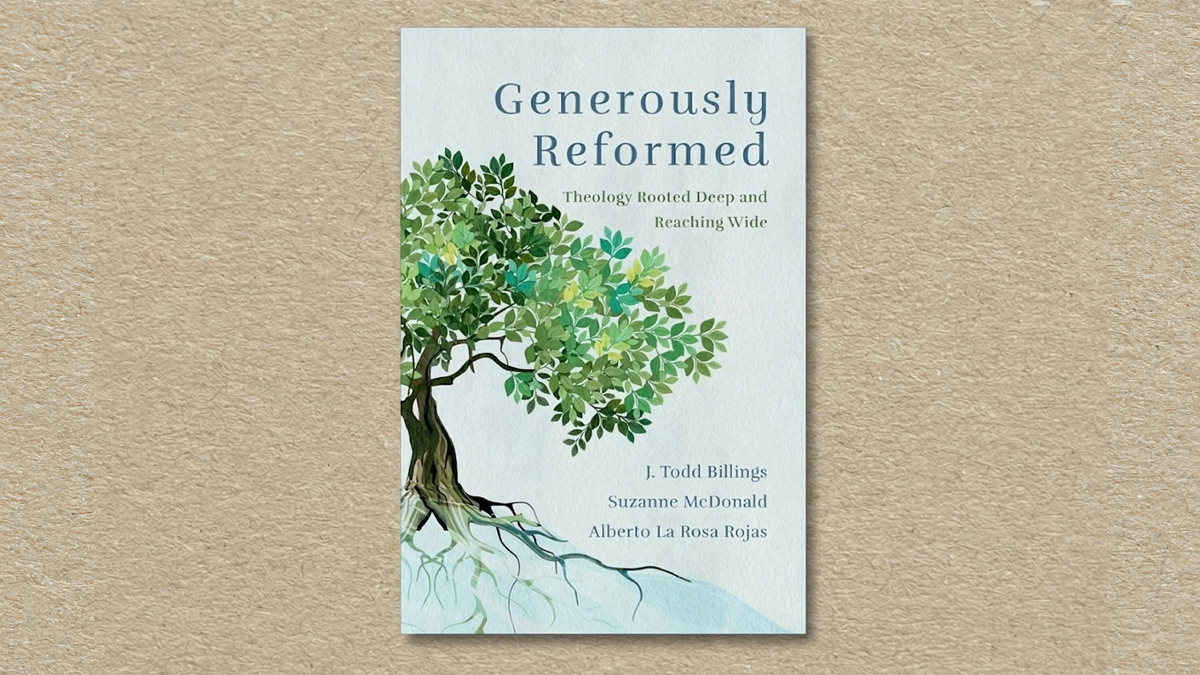
Generously Reformed: Theology Rooted Deep and Reaching Wide
J. Todd Billings, Suzanne McDonald, and Alberto La Rosa Rojas
Purchase on AmazonGenerously Reformed: Theology Rooted Deep and Reaching Wide
J. Todd Billings, Suzanne McDonald, and Alberto La Rosa Rojas
In this volume, J. Todd Billings, Suzanne McDonald, and Alberto La Rosa Rojas—all professors at Western Theological Seminary (an institution founded in 1866 by the Reformed Church in America, North America’s oldest Reformed denomination)—set out to respond to the caricatures, not by minimizing difficult doctrines of the Reformed tradition, but by filling out a larger picture, and so offering a corrective to how the Reformed faith is often presented.
Getting the Proportions Right
If the tendency has been to define the Reformed tradition by centering terms like “predestination” and “depravity,” the picture painted by the authors still accounts for these. But when we back up to see the whole, we find Jesus is at the centre of the Reformed landscape, and doctrines that often dominate accounts of “what it means to be Reformed” are set in less central places on the canvas. (Predestination can be spotted in the clouds, perhaps, and depravity somewhere under Jesus’ feet.)
The book begins by introducing us to the dissonance between certain popular accounts of the tradition and the Reformed tradition as the authors know it—“a spacious, compelling, and worshipful place for living as Christians in our complex world today” (xv). While some may be nervous about identifying with the Reformed tradition, preferring something more “catholic” or “evangelical” or “biblical”, the authors insist that to participate in the one body of Christ—the historic church catholic through time—is necessarily to participate in a tradition. The only question is, Which tradition? And, they contend, the Reformed tradition in fact provides “a deeply biblical, refreshingly God-centered, and profoundly generative pathway into the catholic Christian faith” (xxiii).
Definitions
The first chapter engages the surprisingly difficult task of giving definition to “Reformed theology.” The authors explain why the typical shorthand explanations—the “five solas”, the “five points of Calvinism”, covenant theology—each fall short of providing a suitable definition. That’s because none of these explanations were intended to summarize the whole Reformed faith, and in fact each was offered, historically, in response to some particular issue or error in the church. We must therefore take a longer route to defining the Reformed faith.
Chapter two responds to those who see the Reformed faith promulgating a (white) ethnocentric agenda. In response, the authors readily acknowledge the weaknesses and failures of the Reformed church in these (and other) regards, and at the same time help readers to see its “multivalent catholicity” as a tradition that has taken root, and indeed now has its centre of gravity (population-wise), outside of the West. Nevertheless, they explain, as wonderfully multiethnic and multinational as the Reformed faith has become, we must remain attentive to the ways that the sins of ethnocentrism and racism persist—and must be willing to stand against such sins even as they are displayed in some of the Reformed tradition’s most prominent and influential thinkers, ever embracing “the non-innocent reality of the people of God” (48).
Difficult Doctrines
Chapters three, four, and five engage the difficult doctrines that one would expect when offering a defense of Reformed theology, particularly to the larger North American evangelical world. The discussion on “Infant Baptism” (chapter 3) helps to set the issue within the context of a Protestant understanding of justification by grace, helpfully demonstrating that the logic of infant baptism in fact coheres with a generally shared understanding of justification by grace through faith even with those who reject the practice.
On “The Mystery of Election” (chapter 4), the authors show that the Canons of Dort (often summarized with the acronym TULIP) set out not to define the Reformed faith as a whole but simply to respond to the theses of the Remonstrants (followers of Jacobus Arminius) which centered on the topic of predestination. To the Reformed churches, historically, election was one issue—and not the central one. Unfortunately, in part for the attention given to this issue at Dort, it has been given outsized importance in defining and explaining Reformed thought. In clarifying some of the ways the so-called “five points of Calvinism” in fact mischaracterize the historic teachings of Dort, the authors offer their own positive vision for election, including possible trajectories for Reformed thought.
“Providence and the Problem of Suffering” (chapter 5) is without a doubt one of the most important chapters in the book, as it offers a corrective to certain popular Reformed accounts of the topic. Where some (purportedly) Reformed pastors and theologians of our day have stoically associated human suffering with God’s predetermined acts, this chapter shows a more nuanced approach in the Reformed tradition. The confessions warn against “undue curiosity” with that which is “beyond our ability to comprehend” (Belgic Confession, 13), and command that “special prudence and care” be taken in handling the “doctrine of this high mystery of predestination” (Westminster Confession of Faith, 3.8). (This is particularly instructive for those who have sought to remove the mystery from predestination and have made this doctrine the leading test for Christian orthodoxy.)
Using language of “divine concurrence” (put simply, that human and divine agencies are not in competition with one another), the authors demonstrate that Reformed thinkers have consistently insisted on distinguishing between primary and secondary causes; between the active and passive will of God; and all of this in a manner that opens (rather than shuts down) the necessity for both gratitude and lament in suffering.
My single disappointment in this otherwise brilliant chapter is not in what was said but in what was not. The chapter concludes, “God is almighty and loving, and terrible things happen. We don’t know why. But we do know where to direct our trust” (116). This is certainly true in the sense that we cannot know the fullness, and often know immensely little, about why suffering happens. But we do know a few things—and they should be affirmed with the Reformed confessions. The Westminster Larger Catechism, for example, asks questions concerning the “estate” of humanity (“sin and misery”) and how this was brought about (“the fall”) and that this fall makes every one of us “liable to all punishments in this world, and that which is to come” (WLC, 23, 27). Such “punishments” are not the direct tit-for-tat judgments for our particular sins but do come justly to sinners, such as we are, and include punishments which are “inward, as a blindness of mind,” or “outward,” such as “evils that befall us in our bodies, names, estates, relations, and employments; together with death itself” (WLC 28). The Reformed tradition has not been coy about “why” terrible things happen—they happen because of sin, and it’s we humans who are at fault and, so, liable to all judgments. I realize this is not a very popular or easy claim to affirm, but it is hard to read the Reformed confessions (much less the Bible) and come away affirming otherwise.
Missions and End Times
Looking to the future, chapters six and seven offer Reformed accounts of the church’s mission and eschatology. “Reformed Theology and the Church’s Mission” (chapter 6) explores the way the Reformed understanding of the duplex gratia (“double grace”) grounds and necessitates a missional impulse. In Christ we are both justified and sanctified. Indeed we are justified in order to do good works. And these good works must be worked out in relation to the world in which we live. Salvation itself is in fact incomplete (or “dead”, to use James’s word) if it is not worked out socially, through good works in the world. So, we must affirm, “evangelistic witness and cultivating social justice are distinct-but-inseparable works of the church” (137).
“Eschatology” (chapter 7) admits that Reformed churches have not always been very vocal when it comes to talking about end times, and unhelpfully so. While the dispensational premillennial theology of the early twentieth century came to capture much of the American evangelical imagination (and beyond), the Reformed churches have typically held to an amillennial position, which affirms the return of Christ at the end of Christ’s present reign. In this creation-affirming account, history is not moving toward the final destruction of (or flight from) the world, but rather toward its renewal and restoration—the redemption of all things in and through Christ. We are not going to escape from this earth, but return to it under the reign of Christ. While heaven will be a temporary abode for those who die before Christ’s second advent, in the end the heavenly Jerusalem will descend for a final marriage between heaven and earth, and all who make up the church will be raised to life, with resurrected bodies made new, to live with the Lord forever. This is our glorious hope. And it changes how we live.
Conclusion
The book certainly lives up to its title. If one is looking for a most generous apologia for the Reformed faith, this will be a useful and shareable resource which I highly recommended. And as with most strengths, a weakness lies on the other side. At times one may wonder what the boundaries are for retaining a meaningful label called “Reformed”. While many would draw a clear line to keep the credo-baptists and congregationalists out from the Reformed camp, such lines in this book are dotted. Barth’s doctrine of election, while clearly departing from (or at least saying more than) the Reformed confessions, is touted as a possible trajectory for Reformed thought. In these ways, the reader may be left wondering where to draw the lines, and how bold those lines should be drawn. Though, perhaps, this too is part of the gift of this book. It opens up, rather than shutting down, even as it compels our eyes to see a larger landscape of what it means to be Reformed—indeed, what it means to be merely “Christian,” since this is what all of the Reformed are most adamantly after.
In the end, one gets the impression that Reformed Christians not only can laugh, but in fact are given the most resources to do so.