


I recently attended a membership class at a Baptist church and got to chat with a fellow attendee about the 1689 Second London Baptist Confession (2LCF). We wondered if the church we had been visiting subscribed to this confession or perhaps how it might have influenced the church’s statement of Faith, particularly the doctrines of God and the Trinity.
I am learning to value how historic confessions, such as the 2LCF, use technical words that are found outside of the Bible to help preserve biblically accurate affirmations about God to help me worship rightly in my church.
Steven Olsen’s A Necessary Consequence
Steven Olsen’s A Necessary Consequence (Pickwick Publications, 2025) assesses the use of confessions from a historical perspective. His monograph focuses on the Salters’ Hall Debates of 1719, which involved contention about the Son’s deity and debate about whether it was necessary to require “ministers to subscribe to confessional statements” (2). Anyone familiar with Baptist and nondenominational church life will recognize that these debates are not limited to history but continue to play out on the contemporary scene.
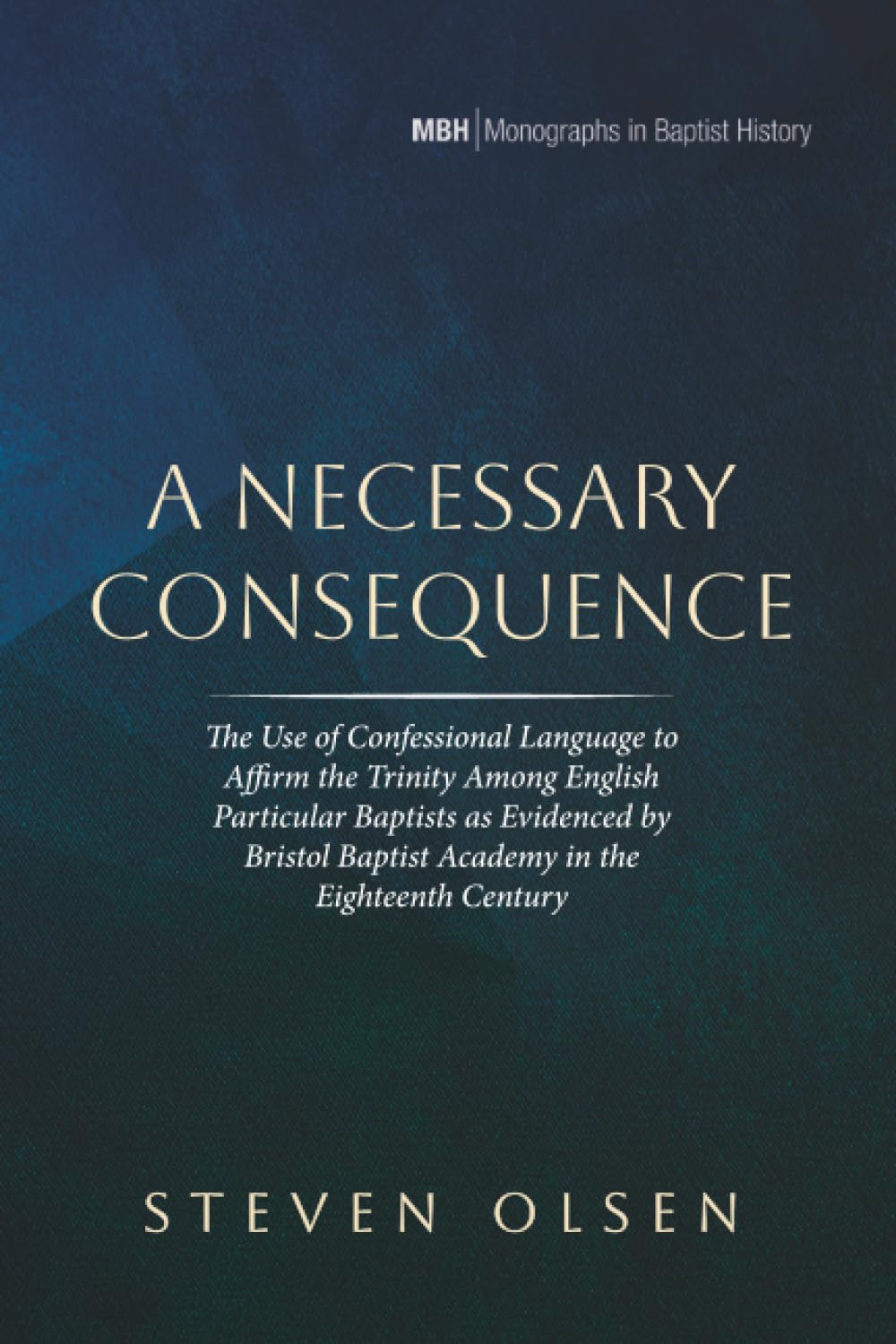
A Necessary Consequence: The Use of Confessional Language to Affirm the Trinity Among English Particular Baptists as Evidenced by Bristol Baptist Academy in the Eighteenth Century, Monographs in Baptist History
Steven Olsen
Purchase on Amazon.caPurchase on Amazon.comA Necessary Consequence: The Use of Confessional Language to Affirm the Trinity Among English Particular Baptists as Evidenced by Bristol Baptist Academy in the Eighteenth Century, Monographs in Baptist History
Steven Olsen
In his case study, Olsen considers “the nonsubscribers,” the group that ultimately won the debate. They “argued that ministers ought to affirm only the language of Scripture as related to the Trinity” (2). Olsen notes that, in time, “[m]any Baptist churches that affirmed only scriptural trinitarian language began to adopt antitrinitarian positions” (2).
In response to this eighteenth-century drift toward antitrinitarianism—and this is Olsen’s thesis—Bristol Baptist Academy anchored English Particular Baptist churches in orthodox trinitarian theology through its use of traditional confessions. The Academy’s professors valued confessional statements and taught their students, future ministry leaders, to confess them too.
Summary of the Book
In eight chapters, the author seeks to show how “Bristol Baptist Academy responded to the debate of Salters’ Hall” and the effect of their response “on the preaching and application of theology by its students in eighteenth-century Baptist churches of England” (2).
Chapter 2 glances back at the seventeenth century for historical context, asking and answering the following question: “Why did a theological debate in a local Presbyterian church in Exeter become so public and heated in London” among “three dissenting denominations” (11)? At bottom, the debates revolved around Protestants’ use of tradition. Olsen examines how various groups of Christians understood the role of tradition in developing biblical doctrine. Olsen outlines how the Reformed principle of sola Scriptura morphed into the Protestant Principle—the idea that we judge what is orthodox by Scripture and not “confessional language” (8).
Chapter 3 focuses on General Baptists in the seventeenth century, giving attention to the unclear, indefinite language used in their confessions (47). Olsen contends that the 1660 Brief Confession’s vague description of the person of Christ is not as clear as the confessions that “utilize classical confessional language” (60), a particularly important point because of the doctrinal issue concerning Christ’s natures (43).
Chapter 4 explores how Particular Baptists responded to antitrinitarianism within their own ranks. Nehemiah Coxe (d. 1689), a Particular Baptist pastor in London, refuted “questionable teachings” on the doctrines of the Trinity and the person of Christ (83). As a result of the disputation, “the 1689 General Baptist Assembly for all Particular Baptist churches” endorsed the Second London Baptist Confession of Faith. Olsen underscores how Coxe affirmed and drew upon the Nicene Creed and the Chalcedonian Definition in the semantically precise language Coxe chose to include in the 2LCF (88–90).
Chapter 5 turns to cover the main event Olsen is concerned with: the Salters’ Hall Debates, which were “about how one ought to expect to state trinitarian doctrine” (125). On one side were the nonsubscribers, who contended that trinitarian doctrine, while biblical, did not need to be stated in confessional formulas beyond Scripture itself. On the other side, subscribers argued that trinitarian doctrine is a logical consequence of Scripture; therefore, ministers should be required to affirm explicit confessional and creedal statements about the Trinity (125).
Following the debates, Olsen directs our attention to how one church and related academy—Broadmead Baptist Church and Bristol Baptist Academy, respectively—responded to the doctrinal differences revealed at the debates. As Bristol Baptist Academy’s first principal, Bernard Foskett tried to convince churches in the Western Association, an association of Particular Baptist churches in the western counties of England, to subscribe to the 2LCF in 1733. Caleb Evans, the third principal, contended that Christian freedom and liberty were not impinged by requiring the affirmation of confessions.
Chapter 6 dives into the substance of the doctrine of the Trinity that the students at Bristol Baptist Academy learned. Olsen submits that the academy’s library, curriculum, and faculty shed light on the school’s commitment to using confessions to teach the doctrine of the Trinity from a classically orthodox perspective (127). Taken together with chapter 5, the reader comes to appreciate how this church and academy put into practice their convictions that confessions and creeds were good for preserving doctrinal fidelity.
Olsen’s well-researched academic project will most benefit history students and teachers, although any reader who enjoys historical studies will appreciate Olsen’s work. His book’s focus on the nature, value, and effects of confessions will encourage Christians to appreciate how creeds and the technical, precise language used in them help believers to flourish. For me, two key takeaways come to mind.
Embrace the Creeds
First, Christians should subscribe to creeds, such as the Nicene-Constantinopolitan Creed (381) and the Chalcedonian Definition (451), because they succinctly summarize orthodox doctrines in axioms, bringing together what the Bible says on a topic. Creeds and confessions can prevent contemporary churches from falling into basic christological errors that the church has already evaluated and spoken clearly about.
Further, these venerable texts can help us think and speak what is true about God and all things in relation to God. For example, the confessions include statements on distinguishing the trinitarian persons: the Father eternally generates the Son, and the Father and the Son eternally spirate the Holy Spirit (see the Third Synod of Toledo [589]).
Choose Your Teachers Carefully
Second, the author reminds us that we should carefully consider where we receive our theological training. It is integral to learn theology from teachers who believe in the historic, orthodox doctrines about God, the Trinity, and the person of Christ—the main topics Olsen treats.
Through the crucible of controversies, the church codified notions such as the triune God’s unity of essence and Christ’s two complete natures that subsist in one person. For anyone considering formal theological education, it is imperative to explore an institution’s teaching on the place of confessions in the Christian faith.
Conclusion
Broadmead Baptist Church and Bristol Baptist Academy’s commitment to the Second London Baptist Confession of Faith encourages me as I continue my membership process. I trust that my leaders convictionally affirm classical confessional language about the Trinity and Christ’s natures, which is their way of preserving good, biblical doctrine. A church’s preference to teach their members the technical, confessional language actually serves the members well because we are discipling people to know and love God more accurately.